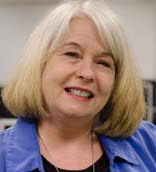
The work of psychologist Jordan Peterson hints to me of a new Integral synthesis of a "world that works for everyone." So I'm migrating this blog to Medium.com where I can write alongside very smart and full-hearted people who are working to get their arms around the possibilities.
My first post there reports on my engagement of protesters at a Peterson event in DC June 8. Please check it out and "Follow" me at Medium, here:
https://tinyurl.com/y9ghtap9
And please note it's not cheating to click the "Clap" icon there as many times as you like to show your support ;>
Teri Murphy
Monday, June 11, 2018


Monday, April 16, 2018
Evolutionary impulse revealing itself through Northern Exposure and Chloride, Arizona
 |
| Saniel Bonder and Linda Groves Bonder |
This was the message of the introductory portion of a workshop by Saniel Bonder and Linda Groves Bonder that I attended last weekend. Saniel is founder of the Waking Down personal growth process, and Linda is his full partner in that work. The workshop was co-sponsored by my Meetup, DC Integral Emergence.
One of the participants, Barbara, commented that "purpose" means something different to her as she ages. I resonated with that. In my case, purpose feels more about process than outcome. In fact, I spent much of the evening musing on the hunger that arose in me during a recent trip to a quirky small town in the desert near Las Vegas. It arose in me as a hunger for geographic community--not just having it, but the process of creating it. I've been fantasizing the many ways a person can help build community in a place where everyone crosses paths once a week to check their mailbox at the post office.
The town is Chloride, Arizona. It's an old wild west mining town now inhabited by retirees who re-enact gunfights for tourists on weekends. With 250 residents and two saloon-style restaurants, it's just the right scale for knowing one's neighbors. Chloride reminded me of another town that's held my heart for decades--Cicely, Alaska, locale of the old TV series Northern Exposure.
 |
| Downtown Chloride, Arizona with post office at left. (Links to a 360 photo at Google maps) |
 |
| Doctor's office in Cicely, Alaska, locale of "Northern Exposure" filmed in Roslyn, WA |
In the best episode of the best TV show of all time, we flash back to the founding of Cicely in its days as a wild west mining camp. Two women, Cicely and Roslyn, undertake to bring culture and upliftment to the lawless spot. In the short term, it doesn't end well, as seen in the quick video clip below. But in the long term, the town shines.
What is seeking to shine through you? That is the question the Bonders led us in pondering.
[Note: I'll be adding my trip reports about Chloride to those at Trip Advisor. If anyone is tempted to co-host a retreat there one day, please get in touch with me.]
Thursday, March 9, 2017
Integral Field Trip to Mens' Rights Documentary "Red Pill"

[March 9, 1917] Mainstream feminists will affirm that rigid gender roles hurt men as well as women. So why is "Red Pill," a film about mens' rights, so controversial?
The documentary chronicles the journey of feminist filmmaker Cassie Jaye who sets out to document the Men’s Rights movement, and ends in questioning her own beliefs. I attended the film this week along with several members of the newly revived DC Integral Meetup. My sense is that the controversy stems from two sources: the polarization that views any acknowledgment of the "other side" as a loss for "my" side, and Jaye's reliance on atmospherics over tough questions that might have clarified a few key points of contention.
For example, she fails to ask the mens' rights activists (referred to in the film as "MRAs") about apparently blatant misogynistic statements several of them have made. And when the editor of MS. Magazine tells her there is no area in which men are unequally treated, Jaye fails to ask for specifics in regard to this list of MRA issues.
 |
| Film maker Cassie Jaye |
Legal and political issues
- Unequal treatment in divorce and child custody, (cited in the film as the top issue that brings men into MRAs)
- Unbalanced military conscription and assignments,
- Disparity in criminal sentencing,
- Lack of services or even sympathy for male victims of domestic violence and rape,
- Disproportionate funding and research on men's health issues, (e.g., research on breast cancer vs. prostate cancer)
- Lack of reproductive rights. (e.g., a say in whether a pregnancy should be terminated)
Social issues
- Lower and still dropping rates of educational attainment in recent decades,
- Much higher rates of workplace fatalities and high-risk jobs,
- Higher rates of suicide,
- Higher rates of violent victimization,
- Societal tolerance of misandry,
- Uniquely subject to false allegations of rape
MRA's Goal: A Commission on Men and Boys
The screening March 7 was sponsored by MRA organizations. Its stated intention was creation of a White House Commission on Men and Boys to parallel the Obama-created Commission on Women and Girls.
Audience Reaction
Audience reaction seemed to indicate that at least half the audience were MRAs. A Q&A session that followed was nearly sidetracked by the question of whether a Trump presidency is a good time to promote such a commission. One young man said it was because President Trump understands the social chaos that has come about since legalization of contraceptives and no-fault divorce. (Ouch!) Another wag pointed out that nothing was accomplished by the Commission for Women and Girls, so why should we expect results from a Commission for Men and Boys?But the discussion also gave voice to attendees seeking to reconcile the two sides, such as these two comments.
"Instead of having a commission for women and a commission for men, let's have one commission that seeks redress for all victims."
"Let's not wait for a government commission. Let's each one mentor young persons of both genders to know that all paths are open to them."
The Integral Perspective
In brief reactions traded after the show, my Integral buddies seemed agreed that Mens' and Womens' issues are not mutually exclusive, but rather tied to each other in several polarities. I wished I could have asked the young Trump supporter if he would like to explore ways to help both men and women move to a new level.Another point about language struck several of us. A woman at the end of the film points out that the term "patriarchy" connotes that men are the problem, while "feminism" connotes that women are the good guys. Integralist Susan Bellchamber said, "I'll never again use 'patriarchy' to summarize the problem."
Perhaps we need only refer instead to "gender assumptions enforced by law and partial awareness." Or, maybe we need something catchier. What do you think?
Wednesday, January 18, 2017
Stumped by Trump? Ken Wilber says evolution calls us to reach out and regroup
"The one thing that was true of Donald Trump—more than any other single characteristic that defined him (more than his sexism, more than his racism, more than his xenophobia)—is that every word out of his mouth was anti-green." Ken Wilber in Trump and a Post-Truth World  |
| The postmodern "green" level of value development hits a wall of re-energized ethnocentrism. Its best move is to regroup and integrate levels it has marginalized so that evolution can move forward. |
"No Truth, No Jobs" (and no respect)
[ED: This article uses the shorthand color names for developmental levels identified in Spiral Dynamics and other developmental schema. "Green" is the postmodern level of pluralism, relativism, and universalism.]
In the paper "Trump and a Post-Truth World," Wilber says green has forfeited its rightful leadership of the culture and must step back to recapture it. He cites two prime causes of Trump's widespread support. First, the over-reach in applying the partial truth that ALL truth is relative,* and second, the loss of jobs in the information economy. But both of these, he says, are exacerbated by the judgments made against those with different values.
"What green was teaching this culture, by example, were sophisticated ways to despise (and deconstruct) those who disagreed with you—they aren’t just wrong, they are the source of every major force of oppression, injustice, slavery, and worse."
Wilber quotes African-American Jeremy Flood (cofounder of At the Margins), in “The Revolution Must Be Felt.” "If our own class-ism prevents us from caring about the emotional needs of those we derided as deplorable, we are not really progressives," Flood says. We are not ‘stronger together’ when half of us are ‘deplorable.’”
The cure, Wilber says, is "to reach out and compassionately include those with other values in the ongoing national dialogue and ongoing cultural normative development." And this, he concludes, will probably mean renewed respect for free speech and some compromise in small business regulation to create jobs.
Personally, I'm thinking to set up a table in my neighborhood just outside DC with a sign that says, "Welcome Deplorables. I hear you. Let's talk."
 |
| My imaginary sign: "Welcome Deplorables." |
Read the full 90 page paper by Ken Wilber for an analysis of the twin fallacies that hold green back: Trump and a Post-Truth World.
______________
* The relative aspects of truth are an essential contribution of postmodernism. But Wilber says they have been stretched too far in three respects.
- "It’s true that all knowledge is context-bound (but some contexts are universal, and thus some knowledge is, too);
- and it’s true that all knowledge is constructed (but it is co-constructed with subsisting intrinsic factors in the actual world, and thus is not just a “fabrication”);
- and it’s true that no perspective is privileged (which actually means that the more perspectives that you include, the more adequate and more accurate your map becomes). "
His contextualizing of these ideas is one of the things I love best about Integral theory. They make it safe again to be excited about Truth, Beauty, and Goodness.
Sunday, June 12, 2016
Film from the Spiral Dynamics Blender: Elmore Leonard's "Touch"

What do you get when a defunct, "Uni-Faith" evangelist and a militant Catholic traditionalist discover, at the same time, a simple Franciscan monk who heals by touch? A very funny and sweet commentary on values that makes a yummy meal for fans of Spiral Dynamics.
Author Elmore Leonard is best known for suspense thrillers of gritty realism like Get Shorty. But in his 1997 film Touch, he makes us laugh while also honoring a simple spirituality outside traditional religion. The plot makes for a tutti-fruity mashup of the values memes that Spiral Dynamics calls us to master.
In a sweet coincidence, my husband Andy stumbled on this movie just as I was preparing to take a class on Spiral Dynamics from Jim Lockard. Lockard is a retired New Thought Minister who has helped my congregation think in evolutionary terms about our future. And he had just published a blog post on ministering to outrage. In "Touch," the Catholic militant leads a group called "Outrage." The best laugh of the movie comes when the militant reveals the name's meaning, "Organization Unifying for Traditional Rites as God Expects."

The militant does some buffoonish and dangerous acts. Yet the movie lends him some dignity for the caring behind his convictions. I'm thinking that might just make it second tier.
Check out this movie. You'll be touched.
Friday, January 1, 2016
God, Science, and Sexy Bananas
 |
| My banana's tail stretched five feet. This one is from Malaysian photographer http://idkhalid.blogspot.com/ |
A Poolside Contemplation of Beauty, Truth, and Goodness
On a recent trip to Florida, I stood awestruck before a banana palm by my hotel room door. I'd seen bananas on the hoof before, but I'd never seen the long tail that proceeds from the bottom of a bunch and ends in a dangling, pointed, orb of smoky-crimson, looking like God's hypnosis pendant or the devil's tail. The tail on this baby was five feet long. I wanted to fall to my knees in adoration.God or evolution? From Wikipedia I learned that the orb is a flower spike known as the inflorescence. Seeking a photo, I misspelled it as "fluorescence." That led me to an article proving that ripe bananas glow in the dark, but only if they're sexy. The article was an absolutely delightful example of the scientific method at work. Author Carolyn Tepolt described her persistent quest as her first several experiments failed to produce glowing bananas. Just as I had been enthralled by the beauty of God's creation, now I was enchanted by the scientist's devotion to truth.
Terry Patten's Integral Spiritual Practice tells us that contemplation is the preferred spiritual practice for both nature worshipers and scientist philosophers. So I chose a poolside-table with a view of the tree and ordered a banana daquiri from the tiki bar. And it was good.
Travel note: You, too, can contemplate fluorescence and inflorescence at the Dolphin Key Resort in Cape Coral/Fort Myers, Florida.
Friday, April 10, 2015
Integral Subtle Energy: Call Notes from New Thought

Some of my friends in New Thought were befuddled by the heavy Buddhist terminology in the first part of a recent Integral Living Room call on Subtle Energy. So I want to share some of the highlights for me, as someone interested in what's next for New Thought.
The many levels of energy described by ancient and contemporary mystics are summarized in Integral as
GROSS: electro-chemical, gravity, etc.
SUBTLE: Images, dreams, visions, the "feeling" of a room, etc.
CAUSAL: "The subtlest possible patterns of consciousness and energy, a fractal pattern of causation that ripples all the way down though subtle and gross realities," as per Corey deVos in his excellent article "What is Subtle Energy."
From a New Thought perspective, it might be said that affirmative prayer (aka treatment) "works" when it shifts us into the realm of Causal energy.
Subtle as the Gateway
But Ken Wilber started out the call by claiming that Subtle states are the gateway to Causal states. All states are available all the time. But you can't skip the gateway. This might explain why treatment starts with an acknowledgment of union with the divine--that opens our awareness to subtle states.
Ken reviewed the tendency in Buddhism to seek escape from form by jumping from Gross to Causal -- from form to emptiness in meditation. He told the story of a great Japanese Zen monk. No matter how much he meditated, he could not cure his headache. Another monk provided the key to healing by telling him to visualize butter melting on his head in a golden glow that flowed down to the ground taking the pain. Visualization employs subtle energy. "Imagine that," said Ken. "A great meditator who didn't know how to cure a basic kundalini headache." (of repressed gross energy)
The need for Subtle energy as a mediator, Ken said, is indicated in Christianity in that nothing transcendent happens between the Father and the Son without the presence of the Holy Spirit -- visualized as a Dove descending at the baptism of Jesus or tongues of fire at his ascent from form. This echoes the New Thought trinity, depicted in the symbol below.
 |
| Science of Mind symbol based on charts by Ernest Holmes. The "V" represents both the devolution of Spirit into form and the evolution of form into Spirit |
Dangers of the Subtle: Transcend and Include
Because a subtle experience is inherently subjective, each person's experiences will be different, Ken said. And this leads many moderns to be "allergic" to subtle experiences as non-scientific fantasy. The opposite danger, he said, is becoming too fascinated by subtle experiences, becoming "addicted" to them. The solution, he said, is Transcend and Include. Transcend the fascination with subtle experiences, but include their useful manifestations.
Start with Mindfulness
But how do we develop awareness of subtle energy? The most useful comment for me was Terry Patten saying that the way to go to a place in the subtle realm is to think about it. Wow, I thought, That simplifies a massive field. Diane Hamilton told of a meditation student who wanted to leave her classes after six years because nothing was happening. She gave him instructions to point out subtle energy experiences he was having but not noticing. It revolutionized his experience and changed his mind to continue.
Bringing the Subtle to Relationships
Terry said that the work of Integral should not primarily be teaching people to achieve samadhis (states of bliss in meditation), but about developing a live engagement with each other in relationships. He called for an "indigenous" Integral approach, not based in Tibetan or other cultures. And for this approach he may have been "off the reservation" of previous Integral discussions. But now he is squarely in the center of them.
Terry said we can think of two kinds of spiritual practice.
- Space-based: in which we wake up to nondual dimensions of consciousness
- Time-based: in which we discover the unique blueprint for our soul's journey using the animating energetics of this world.
Enchantment and Second Person relationship to the Divine
Jeff Salzman told how his primary focus these days is reclaiming the sense of enchantment he had in his traditional religious youth. As he nurtures a Second Person (I-You) communion with the Divine, he likewise communes with all of nature. For example, he said he loves tulips in the springtime. He grows masses of them and surrounds himself with them. He speaks to them, telling them he loves them. And he likes to imagine they love him back. The trouble is, he says, enchantment can go too far. He begins to realize they may not love him because he chops their little heads off. And when he chooses one, is the one next to it lonely or jealous? I love the joyful way Jeff always brings things down to earth.
The Course in Miracles tells us that the Holy Spirit resides in relationships. Second person is about relationships. And relationships, Jeff said, are messy.

This call was offered in advance of an October Integral Living Room workshop in Boulder on Subtle Energy and Soul Work. I may consider going.
Saturday, December 20, 2014
Beta testing HyLighter: speed learning by integrating all documents?

What if you could glance at a document and see the overlaps between your thinking and that of many other readers, including the input of smart machines. Would you learn faster, think bigger, and come up with better solutions to problems? And might such a process support worldwide dissemination of multiple perspectives? This is the dream of genius entrepreneur David Lebow, founder of the startup HyLighter.
In grad school, Lebow set himself the goal of coming up with a new idea for improving education. But after vast research, he realized he was only regurgitating the ideas of others. So he took scissors to his sources and spread clippings across his living room floor, arranging and rearranging ideas to see connections. The result was an "Aha" moment that led him to write an award winning paper that is still influencing how we teach twenty years later.*
It became Lebow's passion to automate his thinking process so that others could benefit it from it. His initial impulse was to help instill love of learning among young students. But the system he developed may equally serve to track terrorists, solve corporate problems, get loans to 3rd world farmers, harmonize world religions, and turn academics into gleeful pigs in slop.
All the World's Sacred Texts
 I met David while he was in the Washington DC area recently to attend Idea Connect. When he told me he was looking for groups to beta test his system, I knew just who to connect him with: my fellow Integral fans at One Spirit Wisdom Integration Circle (OSWIC) who are plumbing the sacred texts of all world religions to find common themes and Integral memes. Indeed it was pigs in slop all the way down when I introduced him to developmental psychologist Barbara Kinney and Pakistani academic Nomi Naeem who works for Brooklyn Public Library while writing a masters thesis on Integral approaches to education. Excited talk of "social sense making" and "curated conversations" hinted at new possibilities for how we learn and work together.
Meaning, Mormons, and Motorcycle Maintenance
Because I used to teach the document commenting system of Adobe Acrobat, I was eager to get a peek at how Hylighter compares. So Lebow gave me a testing account into which I uploaded some Ken Wilber essays and the Sharma-Cook Greuter paper on Polarities and Ego Development. I test drove HyLighter's ability to cross-link documents in the system and on the Web. And within ten minutes I was having that Internet wormhole experience where one delightful stumble-upon leads to another. A Sharma-Cook Greuter reference to too much meaning-making sparked a thought that led me to a book about mythology in Mormonism, Tinkling Cymbals and Sounding Brass. Then I was off to a forum for fans of Robert Pirsig's Zen and the Art of Motorcycle Maintenance, where the instructions to new members fascinated me for twenty minutes and reinforced my belief that Pirsig's work foreshadows Wilber's. I put those links into my comments on the Sharma, Cook Greuter paper. So the question is, will other readers find them to be as titilating as I did?Possibilities and Work to Do
After numerous readers have placed comments, links, and tags in a document, those items can be assembled into various reports including a "mashup" of comments, links and tags common to many documents. Lebow says HyLighter needs several more months to work out bugs and build a sleeker interface. But it already looks to me like a tool that can greatly enhance how we integrate the vast amounts of data we must swim through to reach the new perspectives we need. |
| HyLighter screenshot shows on the left multiple reader comments for each fragment of highlighted text. Comments from many documents can be assembled into a Mashup as illustrated below. |
 |
| Illustration of a Hylighter Mashup showing reader comments from many documents on selected topics. Illustrations from Hylighter.com. |
* Constructivist Values for Instructional Systems Design: Five Principles toward a New Mindset, David Lebow, 1995
Monday, November 3, 2014
Thank God for Michael Dowd: Evidentiary Mystic
 |
| Connie Barlow and Michael Dowd |
Dowd and Barlow demonstrate a belief-busting bundle of contradictions.
Is Dowd a hyperactive nine-year-old or a highly disciplined samurai for goodness?
Is Barlow a bookish intellectual or a warm passionate activist?
Is their marriage a mission trip or a love match?
The answers are Yes! Yes! and Yes! Polarities reconciled. "Both-And" held in precise, dynamic flow. Is this what second tier looks like?

I am eager for answers in the forthcoming "Evidentiary Mystic," the lead article Dowd has contributed to the latest issue of ONEing, the journal of Richard Rohr's Center for Action and Contemplation.
Action and contemplation.
That's it. These two people integrate being and doing in a big bang's worth of passionate energy that fills the space around them with a background radiation of love, purpose, and integrity.
Integral Name Dropping
After the event, my Integral Emergence Meetup buddies hosted Dowd and Barlow for a meal at a Vietnamese Buddhist restaurant, aptly named Present. ("Be careful not to over-emphasize the present," Dowd had said. "If you are in love with time, you will equally honor the past and the future.")
Dowd spoke fluently of knowing every big name in the human potential and Integral communities.
He used to teach the Spiral Dynamics developmental model. Now he argues with his good friend Jeff Salzman that human progress is not inevitable. He feels himself a soul brother with Terry Patten, who also questions the inevitability of progress but passionately advocates holding nature as sacred. He argues with Ken Wilber that a Buddhist metaphysics penetrates Wilber's supposedly metaphysics-free Integral Theory. There is no evidence that consciousness precedes existence, Dowd says.
And yet, this man who says he has "no belief in anything supernatural," radiates the sacred.
Practice as the secret?
How does he do it? I may have found the answer when I rushed home to read chapter 11 in Dowd's book on practices for building evolutionary integrity. Dowd lives by his practices. In the set-up before the main event and in the lunch afterwards, I saw him practice at least three of the "practices" recommended in his chapter. Whether ordering a meal, managing a conversation, expressing gratitude to a host, or sharing stories about the management of sex and addictions, the man walks his talk. And that, more than anything he said in his eloquent and passionate presentation, is what sent me away feeling hopeful and inspired.

Monday, September 8, 2014
New Thought meets Integral in Leesburg, Virginia
The opening yesterday of a New Thought church by an integrally informed minister permitted me to finally cross a bridge between two of my beloved philosophies--as I've depicted here.

Rev. Sunday Coté opened Center for Spiritual Living in Leesburg, Virginia. She is a dear friend and was previously a minister of my Celebration Center congregation in Falls Church. This review and photos of her first service tell the story of her new integrally informed church.
Ken Wilber's beef with the New Age (into which he lumped New Thought) was that the call to "Change your thinking, change your life," was narcissistic when taken to extremes. His wife's cancer was not cured by her thinking healing thoughts. But when the phrase is taken to mean "Take a bigger perspective." it becomes quite congruent with Integral. As to the middle ground -- the definition and limits of the "causal" state of consciousness, I look forward to exploring that with my Integral New Thought buds.
Good luck Rev. Sunday!
Rev. Sunday Coté opened Center for Spiritual Living in Leesburg, Virginia. She is a dear friend and was previously a minister of my Celebration Center congregation in Falls Church. This review and photos of her first service tell the story of her new integrally informed church.
Ken Wilber's beef with the New Age (into which he lumped New Thought) was that the call to "Change your thinking, change your life," was narcissistic when taken to extremes. His wife's cancer was not cured by her thinking healing thoughts. But when the phrase is taken to mean "Take a bigger perspective." it becomes quite congruent with Integral. As to the middle ground -- the definition and limits of the "causal" state of consciousness, I look forward to exploring that with my Integral New Thought buds.
Good luck Rev. Sunday!
Sunday, June 22, 2014
Sacred Minimalist Music: Arvo Pärt vs. "Call the Midwives"

In most of his music, he uses a technique he calls tintinnabulation, which juxtaposes a melody, generally moving from one adjacent note to another without big interval leaps, and its associated triad, the three notes of a chord (do-mi-sol).
“One line is who we are,” the composer said in a 2010 interview with the New York Times, “and the other line is who is holding and takes care of us.”
There’s a trippy inexorability to this technique’s forward motion, which balances a sense of fragility against a sense of purpose, a focus on minutiae against an eye to the whole.Wow. Not only did I want to experience that, I thought perhaps I already had. I was watching the BBC TV series "Call the Midwives." In a 1950s London slum, secular nurses serve side-by-side with nuns, living in the nuns' convent. Each day before the nurses go out to serve poor women in bad conditions, they pass the chapel where the nuns are singing their morning offices, usually just a plainsong version of a psalm. There's a haunting quality and an ambiguity in the nurses reactions: mildly jealous or glad they're spared the ritual?
But theses are no chirpy "Singing Nuns." Babies die, women are beaten, and the music reflects awareness of that suffering. In the stunning Christmas episode of the first season, we hear the plainsong out of the convent. A nun and a nurse are bathing a homeless woman who may not have bathed in years. We begin to hear a psalm, and up behind it comes a continuous tone. Bubbling up from the continuous tone are three notes. The effect is increasingly haunting, compelling. Definite "trippy inexorability." The scene becomes a sacrament.
 |
| Call the Midwives cast |
I thought perhaps Arvo Pärt's music would be like that -- perhaps even that Pärt had written the piece in "Midwives." But no, nothing in the concert affected me like the TV scene had.
Taking Low to new Heights
Pärt's work does take the expression of mournful to new heights. Here's a Youtube comment on his requiem for composer Benjamin Britten.
when your heart is blind, deaf, silent, just cold..The totally ironic thing is, I did not realize it was a requiem while it was playing. What I heard in its mellifluous cacophony was the coming destruction of civilization made bearable by the increasingly insistent tolling bell of Grace.
because you've lost everything you love
when you think you're dying every second, again&again
but you're not capable of feeling anything at all
when the demons in your head wont stop haunting your dreams
Pärt's rippin' up all your scars, & all the pain you felt
in your whole life breaks down on you again
every single tear you spilled in your whole life flows again
one last time
but you know
it's the only cure, your only chance to heal your wounded mind
your only opportunity to find peace
 |
| Sister Bernadette played by Shelagh Turner is lead singer in the crystalline chants of "Midwives" |
Binaural Beats and New Age Music
In both Pärt and Midwives, the sound made me think of binaural beats: a prominent feature in New Age or meditation music designed to carry us to a transcendent level. (Binaural beats are apparent sounds generated in consciousness when two tones at slightly different frequencies are presented separately, one to each ear.)
If Pärt didn't write the Midwives music, who did? Although I was able to buy the piece, Psalm 121, from the Midwives album at Itunes, no information was provided about the background music. I'd like to strip it out and use it in my daily meditation. What is it? Who wrote it? WHERE CAN I GET MORE LIKE IT? If anyone knows, please contact me.
Notes:
Psalm 121 from the Midwives album can be purchased at iTunes or heard here.
Samples of Pärt's music with annotated comments can be heard at the Washington Post review.
While researching, I came across this morsel: muppets do plainchant psalms
Wednesday, October 9, 2013
DIVERGENT: Optimist "Hunger Games," Integralist Dream
"Only those who are divergent can save us"

Integral commentator Jeff Salzman has called for futurist fiction that paints a more constructive picture than your average post-apocalypse. "Divergent," first novel in a trilogy by Veronica Roth, sets the bar, and it does so with concepts that parallel Integral. Millions of young adults are rabid fans of the blockbuster which will be released as a movie in Spring 2014.
Divergent opens in a burned out Chicago where order has been restored by giving each of five factions responsibility for one aspect of the city. Each faction represents one virtue. At age 16, each person chooses whether to stay in the faction of their birth, or transfer to another faction for life.
The factions are remarkably similar to the value levels in Spiral Dynamics. The picture above is from a fan site. I've doctored the colors of each faction to highlight the SD parallels:
- Red for Dauntless/Warrior
- Blue for Selfless Abgenation/Mythic
- Orange for Candor and Erudite, two factions matching the spiral's Efficient Rationalist level
- Green for Amity/Pluralist
- Yellow for Divergent/Integral (not shown above)
Zombie-free "young adult" fiction. But is it Second Tier?

The feeling of the book is wholly first tier so far -- except for this: the way Divergent people can be identified by others is by their reaction to simulations of their greatest fears. Divergents hold simultaneous awareness of multiple realities, and thus are more quickly able to regain composure in a simulation.
No religion, but Christ Consciousness
Divergent does not discuss religion explicitly; God is mentioned only casually. But one Christian review of Divergent says this:
Abnegation seems to be the “Christian” group, or at least religious one. The book notes that almost all the Divergent are raised in Abnegation. As the story unfolds, the idea seems to be that all the other factions are nothing if they are not selfless; in fact, perhaps all the other factions at their core require the influence of Abnegation. The Dauntless are supposed to be fearless – for the sake of others. Amity brings peace –for the sake of others. The Erudite must learn – for the sake of others. Candor speaks truth – for the sake of others. As a Divergent, Beatrice has three of the factions “fully” in her; I wonder if at some point we will meet a Divergent with all five – a type of Christ if you will, the Incarnation, fully everything. That would be very cool.
The same reviewer also makes a comparison to Hunger Games:
Authority figures are treated with appropriate realism. Many are worthy of trust and respect; some are not. They are all trapped in a system doomed for failure, and for that reason are forced to make hard decisions that at times appear to compromise their integrity. This does not build cynicism in the characters (as it did in the Hunger Games) as much as build desire to see justice and truth prevail.Empowered to Leap over Culverts
I am loving the book, and it has empowered me both morally and physically. First, the sentence, "Only the divergent can save us," energized me to speak more forthrightly when I am seeing a situation from multiple perspectives. And second, the heroine in Divergent bravely faces a brutal initiation into her new faction with the thought, "This is my reality now." Immediately afterward I was hiking a cornfield in Pennsylvania Dutch country and found myself leaping over culverts I normally would have detoured around.
Take the Divergent Test
Fans at the fan site are clamoring to take a test to identify their natural faction. I'm hoping some of my Integral friends involved with leadership assessment might have just the thing for them.
Sunday, June 2, 2013
Integral Movie Review: Perspectives on Perspectives in "The Stories We Tell"

Through interviews with each member of Sarah's family, we learn how the polarity mismatch between her vibrant mother Diane and cool father Michael--both actors--led Diane to an affair with a producer, opening the possibility that Michael is not Sarah's biological father. The uncovering of this secret impacts the family in ways that would, indeed, make a great Lifetime made-for-TV movie. And techniques in how the story is told break new ground in that postmodern, twist-it way (leaving me personally feeling first charmed and then manipulated).
But the supposed layering of perspectives that critics are hailing to me amounted only to minor differences in detail--a who-knew-what-when. As such, the story surely provides moving grist for other families touched by affairs. But I see a much more unusual story hidden within. How does Sarah feel about her discovery and its impact on the beloved man who raised her? That is the one intimate detail we never learn, and within it is the key to the story beyond the story.
Sarah Polley goes on a quest to find her biological father. What she discovers will devastate Michael, the man who raised her. And so, to soften the blow, she brilliantly decides to make a documentary, giving him the role of a lifetime as both writer and star. It is a ploy that succeeds magnificently. Michael is able to turn the devastating revelation into an homage to his dead wife and a chance to publicly do the right thing in how he responds. Sarah is let off the hook for exposing Michael to pain and wins Canada's best film of the year.
Now that's a story.
Saturday, April 13, 2013
Rod Dreher's Not-so-Little Way

This top conservative writer--whose work I admire for its balance--does indeed uproot his family to move home during his sister's terrible struggle with cancer. In "The Little Way of Ruthie Leming," Rod recounts his awe at the simple acts of love and support that carry his family through. His sister, Ruthie Leming, was a vivacious and loving teacher with a simple faith in God. We see the lives she touched and how the network of community she helped create supports her family through her crisis. When hearts are breaking over her loss, "the levee holds," he says.
Rod realizes that he has spent his life talking about community while his sister has been creating it. But things get more complicated when he moves his wife and children back to his native St. Francisville, Louisiana, from their cosmopolitan life in Philadelphia. This is actually the second time Rod has moved back home. And as then, he is soon confronted by all the petty, small-mindedness and suppressed feelings that made him bolt from that life as a teenager. Indeed, two terrible secrets are revealed at the book's end which shove his face up against the limitations of this "little way" he has so idealized.
 |
| Rod Dreher at Barnes and Nobel Tysons Corner |
This is not a little way. This is a big way--a way that points toward how to manage so many of the polar values that tear us apart individually and as a society. And it is a way that perhaps is available only to those who choose to circle back in some form. Dreher writes
Because I went away all those years ago, I could come back not out of guilt, but out of love, of my own free choice.Rod Dreher's story supports me in my own roller coaster ride to integrate the polarity of individuality and community. Since my adventures recounted in The Bishop and the Seeker, I dance between the individual expression of my New Thought community and the humility and sacrifice honored at the Black church I was dropped into.
Of course, both those choices are about my needs for community and individuality. What about the needs of my family back in my small town in California? I'd like to think that when the time is right, love will point the way. And then I'll appreciate the nudge from "The Little Way of Ruthie Leming."
Sunday, December 2, 2012
Integral Life of Pi Movie Review

Because reading "Life of Pi" affected me deeply when I was just getting to know Integral, I approached the movie with longing and dread -- both of which were fulfilled. Where many critics saw a sea adventure with a "tacked on introduction," I saw a magnificent example of integration in the life of a small boy in India -- with a tacked on sea adventure for an ending.

The movie does better justice than I might have expected to the boy's attraction to three religions. It even hints at the attractions of each: Hinduism for its lush sensuality of color, incense and dance; Islam for the physicality of its prayer and daily practice, and Christianity for its love. But what most people see in these scenes is a bland commercial for interfaith tolerance. Whereas I see an integration of beauty, truth, and goodness. In the book, for me, Pi is not just absorbing every belief system he comes in contact with. Fueled by his mystical experiences (not in movie), he is instinctively integrating polarities by ignoring beliefs. Here he is, for example, being attracted to Christianity by the warmth of a missionary priest who takes time to sit with him each day.
The first thing that drew me in was disbelief. What? Humanity sins but it's God's Son who pays the price? ... What a downright weird story. What peculiar psychology.
I asked for another story, one that I might find more satisfying. But Father Martin made me understand that the stories that came before it were simply prologue to the Christians...
That a god should put up with adversity I could understand. The gods of Hinduism face their shares of bullies, kidnappers and usurpers. What is the Ramayana but the account of one long bad day for Rama. Adversity, yes. Treachery, yes. But humiliation? Death? Why would God wish that upon Himself? Why not leave death to the mortals? Why make dirty what is beautiful, spoil what is perfect?
Love. That was Father Martin's answer.

The boy's quest to integrate is immune from both his family's insistence that only science can save modern India, and from the objections of the Hindu, Muslim, and Christian clerics who tell him he must choose among religions. Indeed, the movie drops what for me was the climactic scene of the clerics fighting for Pi's soul. Perhaps the director considered it too incendiary--especially post Benghazi. But it was that scene in the book that fused itself with my personal experience like honey on a host (early Catholic childhood analogy alert) such that I couldn't tell where Pi began and I left off.
I was reading "Life of Pi" in 2004 as I was having my own re-introduction to Christianity from a bishop who seemed to cross boundaries of love and firmness in ways that seemed impossible (as recounted in my book, The Bishop and the Seeker.) And just as I was introduced to Islam by an Imam who crusades for applying reason to the ancient stories of his faith (as this post).
As my husband read that scene of interfaith tug-of-war to me in my hospital room following a surgery, I laughed and cried--clutching a pillow to keep my stitches from popping--with that sense of SOMEBODY UNDERSTANDS WHAT I'M GOING THROUGH.
So I have always wanted to enact that scene, and now that the movie has expurgated it, I plan to produce it at a gathering of friends. We'll discuss the movie Dec 8 at a swank club off Dupont Circle which is co-owned by a friend of mine who teaches mythology at Georgetown University. Contact me if you'd like an invite or a re-enactment at your own gathering.
And please tell us below how Life of Pi affected you.
Thursday, August 16, 2012
Integral Fashion Consulting
 |
| My niece Lynn, front, with her sister Peg, several years before gastric bypass surgery |
Initial Appointment
I called Zoe and set up a four-hour appointment at a rate of $50 an hour. Zoe told me that normally, the most efficient process is to do a closet audit at the client's home, then let Zoe pre-shop, and then do a shopping trip with the client. But because Lynn lives almost two hours from Zoe's territory in Baltimore, it would be more efficient to try to do it all in one appointment. Zoe warned me that might not be feasible.
In the initial interview the following week, Lynn told Zoe that her work environment as an administrator is very casual, but she is getting opportunities to meet with higher level people and could use a couple outfits appropriate to that.
Closet Audit
Raised as a military brat, Lynn had her clothes neatly arranged in two closets--one for tops and the other for her one skirt and several pairs of black pants. The tops were arranged by color, from warm to cool to black and white. "You've done half my work for me, Zoe said, asking Lynn to start by trying on all the pants.
"Mom always said black is slimming," Lynn said.
"Yes," said Zoe, "but slimming is more about fit than color. You and I have similar build and coloring, and for us navy sometimes works better than black." She approved the fit of several of the pants and recommended that Lynn "release" the rest.
"Yes, Maam" said Lynn. In fact, over the next hour, Lynn easily released everything Zoe recommended, even things she had recently bought. "You're the expert," she said, as I imagined myself hemming and hawing in the same situation.
 |
| What's in your closet? |
Find that waist
As we moved to the tops, Lynn tried on several with her one skirt. Zoe recommended that she wear the skirt a bit higher, at her slimmest point, to emphasize her womanly shape. This is a signal recommendation of the Style for Hire approach. And indeed, pulling up the bright, southwestern print skirt by an inch from where Lynn normally wore it caused me to say, "Wow, what a difference."
Zoe recommended Lynn release several tops that were too large but keep most of them, saying Lynn has a good eye for fit and color. "Actually, most of these were chosen for me by my 16-year old niece," Lynn said, referring to her sister Peg's "adopted" granddaughter Tia.
Gaps to Fill
At the end, Zoe pronounced that Lynn had a good solid basis to work from. She needed a business suit, a little jacket that could dress up her tops, a couple more skirts including possibly a pencil skirt, and accessories. Because of Lynn's organization and willingness, Zoe said we finished the closet audit in near record time, so we would have time to go shopping on this same appointment.
Shopping
Lynn lives in Woodbridge, Virginia, near the famous regional mall Potomac Mills. So we had lots of places to choose from. She normally shops at budget stores, but she told Zoe she was prepared to spend in the range of $500 for this upgrade. "We can do that easily," Zoe said. "Let's start at Kohls."
At the large, well-lit, and pleasantly arranged Kohls, we split up, meeting back at the dressing room for Lynn to try on items that both she and Zoe approved of. A skirt I found was pronounced a keeper--a short, slim, light nylon with a print similar to the one Lynn already owned, but in muted camel tones and with a flounce at the bottom.
Finding the dress, finding Lynn
The high point of the day came next as Lynn tried on two dresses Zoe selected, both form-fitting, one teal and one wine colored. I don't think I'd have given the dresses a second look on the rack. But as Lynn saw herself in the wine one, tears came to her eyes. There she was. The high waist, low V neck, and gently drape fit her perfectly, and revealed the beautiful shape she had sacrificed so much to achieve. I blinked my eyes, feeling almost as if I were meeting a new person. Zoe led her off to find the perfect necklace.
 |
| Lynn in her new dress |
We fanned out again at Nordstroms Rack, its tightly packed rows of overstock items much more challenging to navigate, but with hidden treasures awaiting. Zoe found a black suit with a short jacket Lynn could also wear with pants. She also found a jacket I actively disliked on the rack, a short denim blue with a bit of a boucle print and a little Channel-style fringe. But when Lynn put it on in the dressing room, wow. It was both professional and fun at the same time. A real statement. But it was too small. So Zoe sent me back out into the jungle as she and Lynn continued to try things. And Eureka, I found it--half way across the store from where Zoe had found the smaller size.
 |
| And a jacket to wear with everything |
We put the Nordstrom's items on hold to make one last stop at Bannana Republic. Zoe said she would prefer a grey or neutral color suit for Lynn, and Banna Republic can be excellent for items that are professional but fashonable, she said. And indeed, she did find two grey suits that were almost right. But the darts didn't fall in the perfect spots, so back to Nordstroms we went to claim our booty. Zoe added a green print scarf she said Lynn could wear with many of her looks.
Putting it all together
I couldn't believe we still had a half hour left of our scheduled four hours. We zipped back to the house where Zoe showed Lynn how to put together outfits using the few new items we'd bought. In just a few tries, Lynn could tie her scarf like a pro. And if the Integral vision is about bringing together truth, beauty, and goodness, I felt like I'd just had an Integral day.
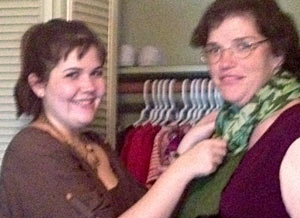 |
| Zoe Jones teaches my niece Lynn to tie a scarf. |
 |
| At work the next day in the skirt I suggeted |
Wednesday, March 7, 2012
Roadtrip: Terry Patten's Encountering the Beloved
More daring than group sex, a chance to pray aloud was the highlight of a Terry Patten workshop on "Encountering the Beloved" in NYC this past weekend. Patten is a hero of mine for pushing Integral theory into embrace of the three faces of God and for his emphasis on daily practice.

Attendees at this workshop were mostly experienced seekers for whom the first day's session was high quality versions of things we'd done before: authentic dialogue in small groups, voice dialogue, and even a chance to dance. What made these extraordinary was Terry's presence and his street-smart, siren call to bring our connection with the Divine into our daily life. (The day also featured lovely listening and touch exercises by Terry's wife Deborah Boyer.)
The workshop was opened by Michael Pergola whose booming, eloquent, anthem to the evolutionary impulse called us to integrate masculine and feminine energies in this time of unprecedented crisis and opportunity. By contrast, Terry's opening sentences were a raw, immediate, plea to authentically acknowledge that most of us must do so while struggling with shadow baggage that leaves us like "bloated bags of protoplasm fiercely struggling to keep our noses above water" in a sea of change. And thus, "Our own 20 watts cannot solve the problems we face," he said. Even though we know there is no God out there in the metaphysical sense we used to believe, we still must find a way to pull down help from the unlimited Divine source. The vulnerability in his tone landed for me like a shepherd's call. I heard his voice; and I was riveted for the remainder of the weekend.


Post-Mythical Prayer
On the second day we did a glorious version of the three body workout which Terry is now calling the 3D workout: stretching our bodies, our sensing souls, and our spirits to the inner, intimate, and infinite faces of God. And then we prayed. Patten does a magnificent job of re-envisioning prayer in a way that opens the possibility of it again for those of us who have left behind the mythical God of our childhood. (The only other person I know with a comparably deft approach to "post-atheist prayer" is Brian McLaren, as I report at Does Mature Conscious Prayer Get Better Results?)
Lurching to Freedom
We broke into groups of three, and I was lucky to have as my partners two beautiful young men who had helped to organize the weekend: Michael Stern and Armando Davila. Going first, I decided NOT to use my comfortable and beloved format: affirmative prayer from New Thought. Instead I lurched and stumbled my way through two minutes of out-loud prayer, trying out several approaches. Next came Armando who said his communion with the Divine often takes him to ecstatic states. His prayer had a simple, direct, quiet, purposefulness. Then came Michael, who spends an hour a day in prayer and meditation. In deep and sonorous tones like the tolling of a cathedral's bell, he called forth the energy of God to share with the world.
Unlike earlier exercises, we didn't share much about ourselves, and yet I felt a strong connection and love among the three of us. And THAT confirmed something I'd been sensing. The quality of "we space" that develops in the two conditions--personal sharing and group prayer-- is completely different and not interchangeable. I need both! I want both! I intend to create both! (I also felt simultaneously grateful for the structure of affirmative prayer, and freed to experiment with other formats.)
My only regret is that I didn't get to hear from every person their experience of that exercise. We did each get a chance to say a final word at the end of the workshop. And in that round, I heard from those who were unmoved by the prayer exercise, as well as from those like my normally quiet homie Bennett Crawford--who radiated a starburst of joy as he told of feeling liberated to pray (see video clip below). Picking up that theme, the next fellow said, "My name is Dan, and I love God," getting a laugh. DC's newest member Jonathan Pratt said that if the world was like the workshop, we'd all live in heaven.
In Love with My Integral Possee
Taking the workshop with members of my practice group from DC doubled the richness of the adventure. I drove up with six fellow members of the DC Integral Emergence Meetup: Coordinators Malcolm Pettus and Anita Conner, Barbara Kinney, Bennett Crawford, and intrepid newbie Jonathan Pratt. We used the car ride up and back to get to know each other at deeper levels, developing a bond of love we didn't want to break at the end of the ride back home.
More to Come
The workshop was the first in a series organized by volunteers from the new organizations Integral Alignment and Universal Consciousness. We'll be back.
UP Next: tomorrow on my other blog, I will report on my meeting later today with the head of the DC Meetup on Emerging Christianity. Crossover?

 |
| Terry Patten |
 |
| Michael Pergola |


 |
| Deborah Boyer left, as Terry and Malcolm encounter the Beloved. |
 |
| The workshop was held at the lovely TAI Center near Madison Square Garden. |
Post-Mythical Prayer
On the second day we did a glorious version of the three body workout which Terry is now calling the 3D workout: stretching our bodies, our sensing souls, and our spirits to the inner, intimate, and infinite faces of God. And then we prayed. Patten does a magnificent job of re-envisioning prayer in a way that opens the possibility of it again for those of us who have left behind the mythical God of our childhood. (The only other person I know with a comparably deft approach to "post-atheist prayer" is Brian McLaren, as I report at Does Mature Conscious Prayer Get Better Results?)
Lurching to Freedom
We broke into groups of three, and I was lucky to have as my partners two beautiful young men who had helped to organize the weekend: Michael Stern and Armando Davila. Going first, I decided NOT to use my comfortable and beloved format: affirmative prayer from New Thought. Instead I lurched and stumbled my way through two minutes of out-loud prayer, trying out several approaches. Next came Armando who said his communion with the Divine often takes him to ecstatic states. His prayer had a simple, direct, quiet, purposefulness. Then came Michael, who spends an hour a day in prayer and meditation. In deep and sonorous tones like the tolling of a cathedral's bell, he called forth the energy of God to share with the world.
Unlike earlier exercises, we didn't share much about ourselves, and yet I felt a strong connection and love among the three of us. And THAT confirmed something I'd been sensing. The quality of "we space" that develops in the two conditions--personal sharing and group prayer-- is completely different and not interchangeable. I need both! I want both! I intend to create both! (I also felt simultaneously grateful for the structure of affirmative prayer, and freed to experiment with other formats.)
My only regret is that I didn't get to hear from every person their experience of that exercise. We did each get a chance to say a final word at the end of the workshop. And in that round, I heard from those who were unmoved by the prayer exercise, as well as from those like my normally quiet homie Bennett Crawford--who radiated a starburst of joy as he told of feeling liberated to pray (see video clip below). Picking up that theme, the next fellow said, "My name is Dan, and I love God," getting a laugh. DC's newest member Jonathan Pratt said that if the world was like the workshop, we'd all live in heaven.
Bennett Crawford shares his experience at the end of the workshop
In Love with My Integral Possee
Taking the workshop with members of my practice group from DC doubled the richness of the adventure. I drove up with six fellow members of the DC Integral Emergence Meetup: Coordinators Malcolm Pettus and Anita Conner, Barbara Kinney, Bennett Crawford, and intrepid newbie Jonathan Pratt. We used the car ride up and back to get to know each other at deeper levels, developing a bond of love we didn't want to break at the end of the ride back home.
 |
| DC Integral Emergence Coordinators Malcolm Pettus and Anita Conner drive us to Terry Patten workshop in NYC. Take us out, Mr. Zulu. |
 |
| DC crew at Tryp Hotel from left: Teri Murphy, Anita Conner, Bennett Crawford, Barbara Kinney, Jonathan Pratt, and Malcolm Pettus, with our new friend Nomi, a Pakastani American interested in development within Islam and currently in One Spirit's Integral Mentoring and Ministry program. |
 |
| The DC crew at a great Thai restaurant around the corner from the Tryp on 9th Ave. |
The workshop was the first in a series organized by volunteers from the new organizations Integral Alignment and Universal Consciousness. We'll be back.
 |
| DC crew packs up for home. |
Subscribe to:
Posts (Atom)


 Posts
Posts