A bracing sermon given by my book's co-author, Bishop Phil Thomas, on the Sunday before the inauguration of President Obama.
Bishop Thomas has never been one for the niceties of political correctness, but I love the sweet & sour way he mixes in-your-face truth with calls for peacemaking dialogue. My blogging buddy Karl argues that a true transpartisan is one who is willing to make both sides mad. This might fit the bill.
Showing posts with label transpartisan. Show all posts
Showing posts with label transpartisan. Show all posts
Thursday, January 22, 2009


Friday, October 24, 2008
Transpartisan Values 2: Measuring Them
In Part 1 of this post I noted that Jonathan Haidt's "Real Difference Between Liberals and Conservatives" fueled my belief that conservative and liberal values converge as we mature, birthing integral transpartisans. If that's true, the historic opportunities of Obama's presidency require us to recognize this new animal. For starters, let's see how we might use data like Haidt's to identify integral conservatives.
Caveat 1: My Political Bias
To understand my bias, see my post Why I am a Recovering Libertarian.
Caveat 2: Fools Rush In
I don't know much about tests to measure your level of development; what I know is from a conference call in 2007 with David Zeitler of Integral Institute. My impression is that the available tests are big, complex, and expensive. So this post is a case of fools rushing in where the really smart guys advise caution.
Sorting most conservatives from most liberals
The questions in Haidt's Five Foundations survey are simplistic, but as such they are perfect for filtering most liberals from most conservatives. For the moment I'm going to go with Karl's assumption that most conservatives are at purple-red-blue-orange (in Spiral Dynamics), while most liberals are at blue-orange-green. But I also suspect that some liberals are lower while some conservatives are higher. And remember, according to Integral Theory, "higher" means having a broader perspective that encompasses more experience.
The preamble to all questions in Haidt's Five Foundations survey is, "When you decide whether something is right or wrong, to what extent are the following relevant to your thinking? " One of the questions asks "Whether or not someone showed a lack of respect for authority." It seems likely that
Human guniea pig: my own results on Haidt's survey
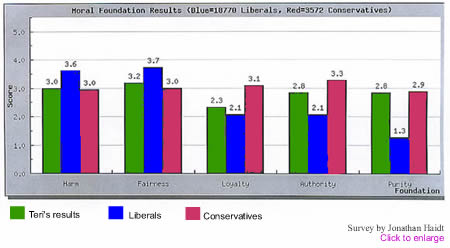
Considerations like these show up in my own test results shown in the chart below:
Screening for Transpartisans
How do we enhance a survey like Haidt's to make such a distinction? I think Karl is right (see his comment on my prior post); Each level has a primary value against which it filters or screens all other values. Thus, liberals at green or ornage screen out value on place on purity, loyalty, and sanctity to avoid any possible conflict with their primary values of fairness and protection from harm. Thus, our questions would need to screen for
Step 1: find the liberals who hold all five values
Our first test would use questions like those in Haidt's Five Foundations survey and simply pad them with qualifiers.
Step 2: Filter out the blue
Presumably we now have a pool of blue, yellow, and beyond. The next step is to sort out those at blue: those who will always prioritize purity, loyalty, and authority as predicted by the spiral, and those whose scope of care is less than worldcentric. This sorting so would require questions carefully designed to get at the motives or perspectives behind the answers.
If these two steps indeed filtered blue, orange, and green, I suspect they would also filter out most of those with a strong political identification as liberal or conservative. Those left will identify themselves politically as independent, libertarian, or "other." These are our potential transpartisans. And I believe that if you ask them how they identified themselves previously, you will get a mix of those who have transcended both "liberal" and "conservative" labels. (More about why/how in a future post.)
Know it when I see it
But the more I look at this, the more I realize the big boys are right: no test can sort the levels adequately--partly because nobody could be trusted to score it. For me it boils down to having conservative friends whose behavior over an extended period tells me they're at integral--or higher. They take big risks to prevent harm to people outside their ingroups; they agonize over questions of appropriate authority; and they realize that whatever form salvation comes in, it must be available to all.
Can we reach out a hand to these transpartisans whose path to integral may have been so different from our own?
Caveat 1: My Political Bias
To understand my bias, see my post Why I am a Recovering Libertarian.
Caveat 2: Fools Rush In
I don't know much about tests to measure your level of development; what I know is from a conference call in 2007 with David Zeitler of Integral Institute. My impression is that the available tests are big, complex, and expensive. So this post is a case of fools rushing in where the really smart guys advise caution.
Sorting most conservatives from most liberals
The questions in Haidt's Five Foundations survey are simplistic, but as such they are perfect for filtering most liberals from most conservatives. For the moment I'm going to go with Karl's assumption that most conservatives are at purple-red-blue-orange (in Spiral Dynamics), while most liberals are at blue-orange-green. But I also suspect that some liberals are lower while some conservatives are higher. And remember, according to Integral Theory, "higher" means having a broader perspective that encompasses more experience.
The preamble to all questions in Haidt's Five Foundations survey is, "When you decide whether something is right or wrong, to what extent are the following relevant to your thinking? " One of the questions asks "Whether or not someone showed a lack of respect for authority." It seems likely that
- A conservative at blue is going to choose "Very Relevant" fast enough to make your head spin.
- A liberal at green is going to be just as fast to choose "Not Very Relevant."
- But everybody else is going to pause. Any liberals at the conventional level may well think, Most conservatives respect authority too much; I don't want to be associated with conservatives, so I will downshift my answer a notch or two, perhaps to "slightly relevant."
- And anyone at the yellow level or above is going to start asking questions about the context.
- Is it a legitimate authority?
- Did the authority violate its trust?
- Were all respectful options exhausted?
- Was the system itself at risk of harm?
Human guniea pig: my own results on Haidt's survey
Considerations like these show up in my own test results shown in the chart below:
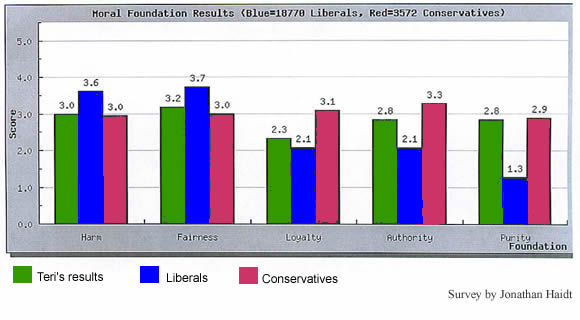
- With liberals, I ranked low on loyalty. (I'd only die for my country if I thought we were protecting someone from harm)
- With conservatives I ranked high on purity/sanctity. But I'm a libertarian on purity (e.g., not only are laws against homosexuality wrong, but laws against drugs and prostitution are wrong, too). So what's up with that ranking? Could it be the hour I spent trying to decide my answer to the weight on "what God wants"? (For more on purity and sanctity, see my One chart that Explains Religion.)
- With conservatives I ranked a bit lower than liberals on harm and fairness. Regarding harm, I can remember the exact day I down-shifted. Someone had to be removed from a team to keep from holding the team back. I agonized over the decision as someone I respected said, "I see why you have to do this, but she will be hurt." I did it anyway and hoped I never had to make a decision like that again.
- On respect for authority, I ranked half way between the liberals and conservatives, perhaps largely because of the experience I just mentioned
Screening for Transpartisans
How do we enhance a survey like Haidt's to make such a distinction? I think Karl is right (see his comment on my prior post); Each level has a primary value against which it filters or screens all other values. Thus, liberals at green or ornage screen out value on place on purity, loyalty, and sanctity to avoid any possible conflict with their primary values of fairness and protection from harm. Thus, our questions would need to screen for
- the person's primary ethical value (e.g., those for whom fairness and care always trump purity, loyalty, and authority.)
- the scope of the ingroup to which loyalty, fairness, and care are applied (family, tribe, or world)
Step 1: find the liberals who hold all five values
Our first test would use questions like those in Haidt's Five Foundations survey and simply pad them with qualifiers.
- A generic qualifier at the start that would reassure the libertarians that "These questions do not concern the passing of laws or use of punishment. They deal solely with how you personally feel about what is right and wrong."
- A qualifier specific to each question for anyone at post conventional, e.g., "In a situation in which you personally believe that someone showed a lack of respect for legitimate authority..."
Step 2: Filter out the blue
Presumably we now have a pool of blue, yellow, and beyond. The next step is to sort out those at blue: those who will always prioritize purity, loyalty, and authority as predicted by the spiral, and those whose scope of care is less than worldcentric. This sorting so would require questions carefully designed to get at the motives or perspectives behind the answers.
If these two steps indeed filtered blue, orange, and green, I suspect they would also filter out most of those with a strong political identification as liberal or conservative. Those left will identify themselves politically as independent, libertarian, or "other." These are our potential transpartisans. And I believe that if you ask them how they identified themselves previously, you will get a mix of those who have transcended both "liberal" and "conservative" labels. (More about why/how in a future post.)
Know it when I see it
But the more I look at this, the more I realize the big boys are right: no test can sort the levels adequately--partly because nobody could be trusted to score it. For me it boils down to having conservative friends whose behavior over an extended period tells me they're at integral--or higher. They take big risks to prevent harm to people outside their ingroups; they agonize over questions of appropriate authority; and they realize that whatever form salvation comes in, it must be available to all.
Can we reach out a hand to these transpartisans whose path to integral may have been so different from our own?
Tuesday, October 21, 2008
Transpartisan Values 1: Liberal and Conservative?
You know how it is when you leave a partner or a paradigm behind, you focus on everything that was wrong with it? I have a suspicion that's what's at work for many of us when we outgrow and turn against values we were raised with—like loyalty to our ingroup. Integral Theory tells me there are higher levels at which we re-integrate those values; we transcend and include them. And I believe that when we get to those levels, former "liberals" and "conservatives" will meet up as integral transpartisans.
Five universal values
I got a new way to think about this in Jonathan Haidt's "The Real Difference between Liberals and Conservatives." In his TED video, the social psychologist tells his mostly liberal audience they could achieve more of their agenda if they'd drop some of their prejudices against conservatives. Unfortunately his talk introduces his findings in a way that could be offensive to conservatives, thus diluting his effectiveness. But his message is clear in the paper in which he defends his "Five Foundations Theory." It claims that five values undergrid the world's many moralities, but liberals and conservatives emphasize the values differently.
He says liberals and conservatives value these two about equally
Beyond Merely Acknowledging Conservative Values
I can hear most of my integral buddies saying, "OK, fine, conservatives have ethical values. But Spiral Dynamics shows us they are low-end ethics." And that's half true. But mapping Haidt's data against the spiral makes it clearer than ever to me why we must reintegrate those "conservative" values as we reach the higher levels. Haidt implies this by asking, "Why has the moral domain shrunk for educated secular Westerners?" Instead of merely transcending and tolerating conservative values, we must also find a way to include them.
Research indeed backs up the liberal feeling that some conservatives' ethics are lower. (An integral perspective tells us that a "higher" value is one with a bigger perspective—it takes more into account.) In Kohlberg's famous stages of development, purity, respect for authority, and loyalty arise in the early stages (pre-conventional and conventional), while care and fairness arise in the later post-conventional stages. [Update: Whoops, that last clause is wrong, as pointed out in Karl's comment below. Care & fairness emerge early. But they are weak until post-conventional because they are overshadowed by the primary values at the lower levels, and they are applied only to one's ingroup.] Thus Haidt asks whether the three conservative values are "just manifestations of Kolhberg's 'immature' conventional morality stages." If we look through the lens of an integral perspective, the answer is "yes" in the lower stages but "maybe not" as we approach the top.
One of Integral's best tools is Spiral Dynamics, a scheme which elaborates on Kohlberg's stages with the insight that values emerge in a natural progression that loops from concern for the individual to concern for the group. Haidt's five values map perfectly to the Spiral levels as shown below.
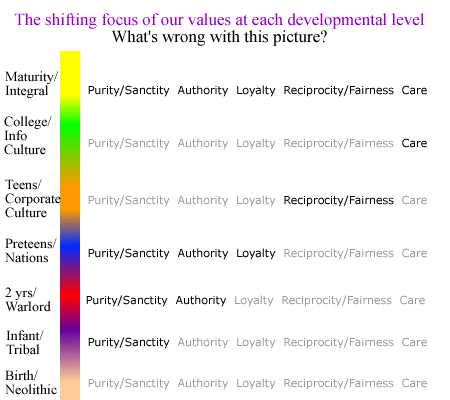
(The grayed values are inactive, and the line of grayed values at the bottom level represents my inclination to go along with Haidt's claim that we are born with a "taste bud" for these values. This contradicts Spiral Dynamics' claim that values emerge from experience. But it's my chart, so I'm going out on that limb.)
At first glance at this chart, liberals may be tempted to say, "See, our orange/green values are higher than conservatives' red/blue values." For even when blues try to be good Samaritans, providing care to an outgroup, they can only provide the kind of care they themselves would want. It's not till green that we can take another's perspective--love our neighbor as ourselves.
But look closely and notice what happens at the orange level of teens, corporate culture, and the Enlightenment. Up until this level, the values have been coming into focus and staying in focus. But Haidt's findings seem to suggest that the teenager now breaks with convention, rejects the first-flowering values of purity/sanctity, authority, and loyalty, and he or she substitutes the new values of reciprocity/fairness and then care/protection from harm. We feel we have transcended the "lower" values. In the case of loyalty, for example, we shift our loyalty from our ingroup to all humans, or to an ideal, or even to ourselves, recasting it as "to thine own self be true." "Loyalty" feels outdated.
Integrating all five at the high end
But notice the yellow "integral" level at the top of the chart. This is the level at which we integrate the values of all prior levels. This is the level at which we reclaim the previously transcended values. We see that authority, loyalty, purity, and sanctity have a rightful place in higher level morality and we want them back.
We'll know we have thus transcended and included each of these values when we can consciously choose among them from a broader perspective. Indications that we are at this level include
So who holds all five values?
If people at the upper level weigh all five values, why doesn't Haidt's research show any liberals holding all five values? I can see three reasons.
Distinguishing high level values from low level
The problem is, it can be impossible to tell the difference between someone acting at a higher level (with a broader perspective) and someone at a less mature level.
Let's take, for example, Sarah Palin's demotion of her state trooper brother-in-law. From the publicly available details, it appears Palin chose loyalty over reciprocity and even over respect for authority. Most everyone will agree that would be wrong and extremely dangerous in a public leader. But if you are a conservative pre-disposed to like Palin, you may look for evidence there were extenuating circumstances such that she did what she felt she had to do to protect her family from imminent harm. On the other hand, if you are a liberal pre-disposed to dislike Palin, you are more likely to assume she acted from the shadow side of loyalty, taking revenge into her own hands. From the outside, those two acts look the same.
And that's what's wrong with so much religious and political debate today. We assume the highest motives for our side and assume the lowest for the other side. What could happen if we flipped that script—checking ourselves for lower motives while giving our opponent the benefit of the doubt about theirs? My experience shows that the release of pressure we get when we do so creates space for something new to happen.
Haidt seems to agree.
Five universal values
I got a new way to think about this in Jonathan Haidt's "The Real Difference between Liberals and Conservatives." In his TED video, the social psychologist tells his mostly liberal audience they could achieve more of their agenda if they'd drop some of their prejudices against conservatives. Unfortunately his talk introduces his findings in a way that could be offensive to conservatives, thus diluting his effectiveness. But his message is clear in the paper in which he defends his "Five Foundations Theory." It claims that five values undergrid the world's many moralities, but liberals and conservatives emphasize the values differently.
He says liberals and conservatives value these two about equally
- Care/Protection from Harm
- Reciprocity/Fairness
- Authority/Respect
- Loyalty/Ingroup
- Purity/Sanctity
We in psychology, and in academe more generally, have a tendency to reject conservative concerns related to ingroup, authority, and purity as "bad" on the grounds that they often conflict with the "good" moralities of harm and fairness. We dismiss the conservative outgroup's morality as "motivated social cognition" driven by non-moral concerns such as fear of change. Doing so makes us feel good, but it should not, for it is a violation of our values (we become "politico-centric"), and it is a route to irrelevance (we cannot persuade the electorate, because we do not have an accurate picture of their moral motivations)...I can say a loud "Amen" based on my experience living among the fundamentalists for two years. When I worked hard to understand their concerns about homosexuality, the result was a willingness to drop their support of gay marriage bans—because, "Judgment is up to God, not the government." While this outcome is not wholly satisfactory to many, the question is, would you rather make progress like this or is it more important to keep proving how wrong the other side is?
[For example] Conservatives and many moderates are opposed to gay marriage in part due to moral intuitions related to ingroup, authority, and purity, and these concerns should be addressed, rather than dismissed contemptuously... Recognizing these foundations as moral (instead of amoral, immoral, or just plain stupid) can open a door in the wall that separates liberals and conservatives when they try to discuss moral issues.
Beyond Merely Acknowledging Conservative Values
I can hear most of my integral buddies saying, "OK, fine, conservatives have ethical values. But Spiral Dynamics shows us they are low-end ethics." And that's half true. But mapping Haidt's data against the spiral makes it clearer than ever to me why we must reintegrate those "conservative" values as we reach the higher levels. Haidt implies this by asking, "Why has the moral domain shrunk for educated secular Westerners?" Instead of merely transcending and tolerating conservative values, we must also find a way to include them.
Research indeed backs up the liberal feeling that some conservatives' ethics are lower. (An integral perspective tells us that a "higher" value is one with a bigger perspective—it takes more into account.) In Kohlberg's famous stages of development, purity, respect for authority, and loyalty arise in the early stages (pre-conventional and conventional), while care and fairness arise in the later post-conventional stages. [Update: Whoops, that last clause is wrong, as pointed out in Karl's comment below. Care & fairness emerge early. But they are weak until post-conventional because they are overshadowed by the primary values at the lower levels, and they are applied only to one's ingroup.] Thus Haidt asks whether the three conservative values are "just manifestations of Kolhberg's 'immature' conventional morality stages." If we look through the lens of an integral perspective, the answer is "yes" in the lower stages but "maybe not" as we approach the top.
One of Integral's best tools is Spiral Dynamics, a scheme which elaborates on Kohlberg's stages with the insight that values emerge in a natural progression that loops from concern for the individual to concern for the group. Haidt's five values map perfectly to the Spiral levels as shown below.
(The grayed values are inactive, and the line of grayed values at the bottom level represents my inclination to go along with Haidt's claim that we are born with a "taste bud" for these values. This contradicts Spiral Dynamics' claim that values emerge from experience. But it's my chart, so I'm going out on that limb.)
At first glance at this chart, liberals may be tempted to say, "See, our orange/green values are higher than conservatives' red/blue values." For even when blues try to be good Samaritans, providing care to an outgroup, they can only provide the kind of care they themselves would want. It's not till green that we can take another's perspective--love our neighbor as ourselves.
But look closely and notice what happens at the orange level of teens, corporate culture, and the Enlightenment. Up until this level, the values have been coming into focus and staying in focus. But Haidt's findings seem to suggest that the teenager now breaks with convention, rejects the first-flowering values of purity/sanctity, authority, and loyalty, and he or she substitutes the new values of reciprocity/fairness and then care/protection from harm. We feel we have transcended the "lower" values. In the case of loyalty, for example, we shift our loyalty from our ingroup to all humans, or to an ideal, or even to ourselves, recasting it as "to thine own self be true." "Loyalty" feels outdated.
Integrating all five at the high end
But notice the yellow "integral" level at the top of the chart. This is the level at which we integrate the values of all prior levels. This is the level at which we reclaim the previously transcended values. We see that authority, loyalty, purity, and sanctity have a rightful place in higher level morality and we want them back.
We'll know we have thus transcended and included each of these values when we can consciously choose among them from a broader perspective. Indications that we are at this level include
- We are not knee-jerk controlled by any one value
- We are passionately for each value without being against the others
- We can access each value when appropriate
- We avoid extremes by integrating opposites: For just as too much loyalty breeds revenge, we come to see that too much reciprocity breeds heartless legalism and too much care breeds what Buddhists call idiot compassion.
- We are not 100% sure we are right but we are willing to make tough choices in full humility that we may be wrong
- We loosen identity with a political party, seeking to become transpartisan
So who holds all five values?
If people at the upper level weigh all five values, why doesn't Haidt's research show any liberals holding all five values? I can see three reasons.
- Haidt's questions aren't designed to sniff out the distinctions in the list above. So a person at the integral level who weighs loyalty to family against loyalty to every other human being may not test out as being "loyal" at all (see Karl's fantastic comment below)
- Haidt apparently drops data from those who identify themselves as "independents," "libertarians," or "other," and those are exactly the categories in which the integral transpartisans may be hiding out
- Ethical values are only a subset of the values that distinguish conservatives from liberals, and those labels don't take into account variation within the two camps--as identified in my One Chart that Explains all Politics
Distinguishing high level values from low level
The problem is, it can be impossible to tell the difference between someone acting at a higher level (with a broader perspective) and someone at a less mature level.
Let's take, for example, Sarah Palin's demotion of her state trooper brother-in-law. From the publicly available details, it appears Palin chose loyalty over reciprocity and even over respect for authority. Most everyone will agree that would be wrong and extremely dangerous in a public leader. But if you are a conservative pre-disposed to like Palin, you may look for evidence there were extenuating circumstances such that she did what she felt she had to do to protect her family from imminent harm. On the other hand, if you are a liberal pre-disposed to dislike Palin, you are more likely to assume she acted from the shadow side of loyalty, taking revenge into her own hands. From the outside, those two acts look the same.
And that's what's wrong with so much religious and political debate today. We assume the highest motives for our side and assume the lowest for the other side. What could happen if we flipped that script—checking ourselves for lower motives while giving our opponent the benefit of the doubt about theirs? My experience shows that the release of pressure we get when we do so creates space for something new to happen.
Haidt seems to agree.
Social justice researchers might benefit from stepping out of the"good versus evil" mindset that is often present in our conferences, our academic publications, and our private conversations. One psychological universal (part of the ingroup foundation) is that when you call someone evil you erect a protective moral wall between yourself and the other, and this wall prevents you from seeing or respecting the other's point of view.My next post will kick around the kinds of survey questions that could distinguish integral transpartians who truly weigh all five values from those conservatives who see themselves as attempting to do so but who always end up privileging the earlier values over the later ones. And I'll be asking for your help. Take a moment to subscribe below so you won't miss a thing.
It's more entertaining to watch people throw rocks at each other over the wall than it is to watch the slow, difficult process of dismantling the wall...
Friday, October 17, 2008
One Chart that Explains Politics
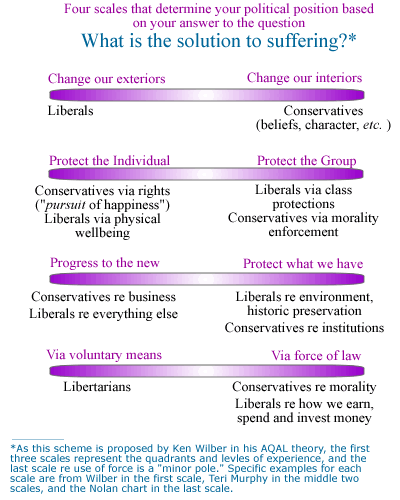
This chart attemps to integrate insights from Ken Wilber's AQAL Theory and David Nolan's Nolan chart. It is a work-in-progress with comments appreciated.
But how does it relate to spirituality and the Purity/Sanctity values identified by Haidt? Just take the top scale, Interiors/Exteriors, and turn it horizontally, heavanward, as in my One Chart that Explains Religion.
Tuesday, October 14, 2008
Why I'm a Recovering Libertarian
I had no political affiliation until I learned the definition of "libertarian" in mid-life. Then, bam, I became an active libertarian for ten years or so. That means, as shown on my One Chart that Explains all Politics, I put more faith in
But I was an unusual libertarian in that I was already into personal growth work and alternative spirituality—1st person God. The cross-over was that my highest value was choice in both religion and politics—not only because freedom to choose feels morally right, but because it is through watching the effects of our choices that we grow. And growth was the real goal.
Dropped in the Blender
Then came the series of events chronicled in my book--being dropped into an extraordinary black fundamentalist church simultaneously with discovering Ken Wilber's integral map of reality. Like falling into a blender set to "whip." Living among people whose lives were emerging from red to blue, (in Spiral Dynamics that means raw power to rules and roles), I saw how besieged they were by drugs, alcohol, porn and worse. And then of course, came the world financial meltdown--fueled essentially by gambling run amok.
I became more aware of the harm to the community of these "consensual acts," as we libertarians like to call the vices. If voluntary compliance can't fully protect us from these, what can?
Capping harm to innocent bystanders
One answer is a very specific kind of regulation that caps harm to innocent bystanders--like laws against drunk driving. In the case of the financial meltdown, I have to confess along with former Fed Chair Alan Greenspan that we were wrong in one piece of deregulation--the one that permitted mortgages to be turned into poker chips (via securitization, making stocks out of them--but I'm still sticking to my libertarian guns that several other regulations helped cause the problem.) The idea of capping harm to bystanders still doesn't mean I think we should jail drug users. But it does soften me to the idea we should jail drug sellers--after all other means of information, inspiration, mediation, rehabilitation, and yes, charity have been exhausted. (And even regarding voluntary charity, I'm softening to the idea that our modern era has stripped away most of the traditions that support it, leaving no recourse at this stage but forcing it via taxes.)
The real trouble is we humans find it too hard to use voluntary means. But my new fundamentalist friends had a stunning answer to one part of the problem: community intervention as laid out in Matthew 18:15-17
A Difficult Ideal to Live up to
Of course, the final step of intervention in the scripture above requires that everyone be a member of a church—or at least a community of shared values. And most of us left churches for applying this solution poorly—with judgment, hypocrisy, and shame. What would it look like if it were applied with love, humility, and dignity? I saw it once, and it took my breath away. In my book I recount interventions on drug abuse, spouse abuse, and out-of-wedlock pregnancy. They weren't all handled perfectly. But the ones that were gave me a new vision of what's possible—in community, with action, and based on a sacred tradition.
Integrating the Opposites
So today, I still believe voluntary means are best for achieving our goals. But I'm more interested in balancing the other parts of the equation: integrating concern for groups with those of individuals, protecting useful traditions while making progress, and taking action while shifting attitudes. And the biggest integration of all, of course, is integrating a sense of the sacred with everything else.
Thus I am feeling less comfortable calling myself a libertarian these days, and more comfortable as a "transpartisan"—one whose political views cross or transcend political parties. But my idea of transpartisan is not a mushy compromise on everything. It is a sharp-edged insistence on integrating the best of everything. And that is why I also call myself an Integralist.
- Individuals over Groups
- Progress over Protecting what we have
- Interiors (beliefs) over Exterior behaviors and institutions, and most important
- Voluntary compliance over Legal Enforcement
But I was an unusual libertarian in that I was already into personal growth work and alternative spirituality—1st person God. The cross-over was that my highest value was choice in both religion and politics—not only because freedom to choose feels morally right, but because it is through watching the effects of our choices that we grow. And growth was the real goal.
Dropped in the Blender
Then came the series of events chronicled in my book--being dropped into an extraordinary black fundamentalist church simultaneously with discovering Ken Wilber's integral map of reality. Like falling into a blender set to "whip." Living among people whose lives were emerging from red to blue, (in Spiral Dynamics that means raw power to rules and roles), I saw how besieged they were by drugs, alcohol, porn and worse. And then of course, came the world financial meltdown--fueled essentially by gambling run amok.
I became more aware of the harm to the community of these "consensual acts," as we libertarians like to call the vices. If voluntary compliance can't fully protect us from these, what can?
Capping harm to innocent bystanders
One answer is a very specific kind of regulation that caps harm to innocent bystanders--like laws against drunk driving. In the case of the financial meltdown, I have to confess along with former Fed Chair Alan Greenspan that we were wrong in one piece of deregulation--the one that permitted mortgages to be turned into poker chips (via securitization, making stocks out of them--but I'm still sticking to my libertarian guns that several other regulations helped cause the problem.) The idea of capping harm to bystanders still doesn't mean I think we should jail drug users. But it does soften me to the idea we should jail drug sellers--after all other means of information, inspiration, mediation, rehabilitation, and yes, charity have been exhausted. (And even regarding voluntary charity, I'm softening to the idea that our modern era has stripped away most of the traditions that support it, leaving no recourse at this stage but forcing it via taxes.)
The real trouble is we humans find it too hard to use voluntary means. But my new fundamentalist friends had a stunning answer to one part of the problem: community intervention as laid out in Matthew 18:15-17
If your brother sins against you, go and show him his fault, just between the two of you. If he listens to you, you have won your brother over. But if he will not listen, take one or two others along, so that every matter may be established by the testimony of two or three witnesses.' If he refuses to listen to them, tell it to the church; and if he refuses to listen even to the church, treat him as you would a pagan or a tax collector.As a libertarian I got a huge laugh about the "tax collector," but I stopped laughing when that line was interpreted as "be polite on the street but stop inviting him to dinner." It made SENSE. It starts with personal responsibility and then builds to a community approach in a very conscious way. It also fits everything I believe about the value of clean interpersonal communication. "We are willing to say what's hard to say and willing to hear what's hard to hear" is how I put it in the personal ad that netted my husband.
A Difficult Ideal to Live up to
Of course, the final step of intervention in the scripture above requires that everyone be a member of a church—or at least a community of shared values. And most of us left churches for applying this solution poorly—with judgment, hypocrisy, and shame. What would it look like if it were applied with love, humility, and dignity? I saw it once, and it took my breath away. In my book I recount interventions on drug abuse, spouse abuse, and out-of-wedlock pregnancy. They weren't all handled perfectly. But the ones that were gave me a new vision of what's possible—in community, with action, and based on a sacred tradition.
Integrating the Opposites
So today, I still believe voluntary means are best for achieving our goals. But I'm more interested in balancing the other parts of the equation: integrating concern for groups with those of individuals, protecting useful traditions while making progress, and taking action while shifting attitudes. And the biggest integration of all, of course, is integrating a sense of the sacred with everything else.
Thus I am feeling less comfortable calling myself a libertarian these days, and more comfortable as a "transpartisan"—one whose political views cross or transcend political parties. But my idea of transpartisan is not a mushy compromise on everything. It is a sharp-edged insistence on integrating the best of everything. And that is why I also call myself an Integralist.
Subscribe to:
Posts (Atom)


 Posts
Posts