"Transcend and include... this is the self-transcending drive of the Kosmos—to go beyond what went before and yet include what went before... to open into the very heart of Spirit-in-action." Ken Wilber, A Brief History of Everything

"Wouldn't it be wonderful if a group of people somewhere were for something and against nothing?" Ernest Holmes
Showing posts with label religion. Show all posts

Thursday, October 16, 2008

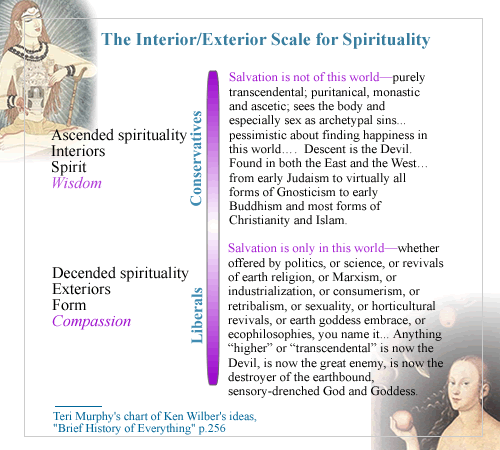
One Chart that Explains Religion

(as it relates to politics)
As I hinted in my post on Jonathan Haidt's "The Real Difference between Liberals and Conservatives," this chart goes a long way toward explaining Haidt's results for purity and sanctity in his survey of the five foundation of morality. In the modern world, the values of purity and sanctity that belong at the top of the chart have been transcended by the authenticity and "whatever feels good do it" ethos at the bottom. This creates the political fights over prayer in schools, Christmas creches, and sexuality laws from the ascenders and over food & environmental regulations from the descenders.

The chart is based in Ken Wilber's insight that the only reliable marker for conservatives and liberals is that conservatives favor interior solutions to suffering and liberals favor exterior solutions. (See my One Chart that Explains all Politics). Superimpose that idea over his concept that we all have a "god" or idea of salvation. He calls these the gods of the "ascending" and "descending" paths.

Wisdom vs. compassion
I personally felt a major breakthrough in dealing with the tension between these two paths when Wilber explained their respective merits. He calls the path of ascent “the path of wisdom” because it sees that behind all the forms there lies,
The One, the good, the unqualifiable Emptiness, against which all forms are seen to be illusory, fleeting, impermanent… Wisdom is the return of the Many to the One.

The path of descent, on the other hand, is the path of compassion. It sees that the One actually manifests as the Many, and so all forms are to be treated equally with kindness, compassion, mercy. … it found its glory in the celebration of diversity. Not greater oneness, but greater variety was the goal of this God... It is a religion of great compassion, little wisdom.
My argument is that one way for us postmoderns to find more wisdom is by appropriately including the purity and sanctity we have transcended. As one potential example, a Sierra Club article argues that if environmentalists want to win over conservatives, they must recast their vision as honoring the sacredness of creation. But it can't just be a spin. It has to be a real vision shift.

When I shared this concept of ascending and descending religion with my favorite fundamentalist, he said, "Oh yeah. That's the horizontal axis and the vertical axis of the cross. It's the job of any good church to balance these two."
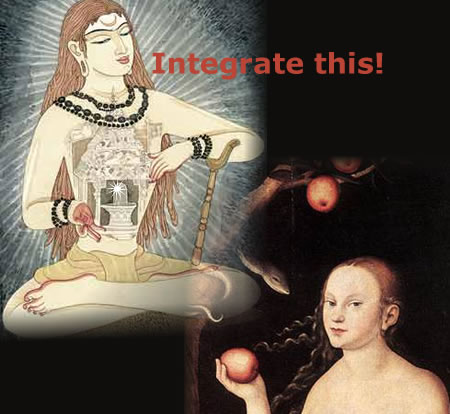
PS: Coincidence...?
I was enjoying creating the graphic above, playing with the fade between the two images, when suddenly the aescetic's walking stick seemed to spurt from Eve's tree. Woo oooh oooh as we used to say in my more New Agey days.

Friday, September 12, 2008

Seven Things All Religions Share

...and three things they don't
I am fascinated by Ken Wilber's list of seven commonalities of all religions.
  1. Spirit, by whatever name, exists.
  2. Spirit, although existing "out there," is found "in here," or revealed within to the open heart and mind.
  3. Most of us don't realize this Spirit within, however, because we are living in a world of sin, separation, or duality-that is, we are living in a fallen, illusory, or fragmented state.
  4. There is a way out of this fallen state (of sin or illusion or disharmony), there is a Path to our liberation.
  5. If we follow this Path to its conclusion, the result is a Rebirth or Enlightenment, a direct experience of Spirit within and without, a Supreme Liberation, which
  6. marks the end of sin and suffering, and
  7. manifests in social action of mercy and compassion on behalf of all sentient beings.
Of course, what everybody disagrees on is the exact nature of the path in #4--though all agree that loving your neighbor as yourself is some part of it.

The two other disagreements
Put clergy members from all faiths in a room for twenty years and they'll come out with a list like the one above plus two apparently irreconcilable differences.
  1. Is Spirit personal or impersonal?
  2. Is man inherently good or bad?
(as reported in The Common Heart, a report of interreligious dialogues at Snowmass. 1984-2204)

These two differences have a lot to do with how one sees "the path." Personally, I can embrace both sides of these two questions, depending on the level of reality we're looking at. But mostly I'm with Wilber that the existence of the seven core commonalities (and many more as well) speaks to the fact that all of us are preceiving the same spiritual reality--just from different perspectives and different levels of maturity.