Recently I saw again one of the most famous episodes of Star Trek Next Generation, "Darmok and Jalad at Tanagra." I sat riveted, seeing with new eyes how this story reflects my adventure with Bishop Thomas and the biblical literalists at Highview.
In the show, Captain Picard confronts an alien race that communicates only via metaphor from its ancient myths--just as my new friends at Highview attempt to solve all problems with stories from the Bible. Struggling to communicate, the alien captain beams himself and Picard to a planet where a beast is loose, and he repeatedly says to Picard, "Darmok and Jalad at Tanagra!" Picard is confused and shivering in the cold until the alien captain offers him fire saying, "Temba, his arms wide!"
Suddenly Picard understands how metaphor is being used. "Temba, his arms wide" is a metaphor for giving and receiving. Then Picard recalls Gilgamesh, one of earth's most ancient legends, a story of how two enemies became friends through hardship. He realizes that "Darmok and Jalad at Tanagra" must be a similar story, and that the alien captain has risked his own life to open communication between
their peoples by fighting the beast together with Picard. Alas, the alien, Dathon, is mortally wounded by the beast. As Dathon dies, Picard shares with him the story of "Gilgamesh and Enkidu at Uruk." Dathon dies knowing he has succeeded in opening communication with Picard. Picard returns to his ship with enough knowledge to halt the war that is brewing with Dathon's people.
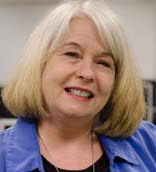
And that is the story in my book, "The Bishop and the Seeker: Wrestling for the Soul of the 21st Century." As a postmodern Integralist and follower of New Thought, I am beamed into the office of a fundamentalist bishop for a year of dialogue where we discover our common enemy: the excesses of postmodernism and alternative religion in which there is no right and wrong. We tell each other stories and learn each others' language. The bishop's equivalent of "Temba, his arms wide" is to offer me the openness to be genuinely interested in learning about my world. In fact, he risks his reputation among some of his own hardliners by telling me he believes I am saved, even though I do not call myself Christian.
I return to my ship to bring the message. We can work with these people, they can be friends. Instead of focusing on our differences, look at the good work we can do by focusing on our common aims to bring truth, beauty, and goodness to the world.
"Transcend and include... this is the self-transcending drive of the Kosmos—to go beyond what went before and yet include what went before... to open into the very heart of Spirit-in-action." Ken Wilber, A Brief History of Everything
"Wouldn't it be wonderful if a group of people somewhere were for something and against nothing?" Ernest Holmes
Showing posts with label dialogue. Show all posts
Wednesday, December 8, 2010
Monday, October 13, 2008
A Black Man Befriends the Klan
Extreme dialog
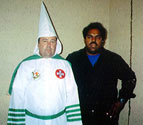
Daryl Davis is a black musician based in Washington whose exuberant piano playing has been compared to that of Jerry Lee Lewis. Davis made it his life mission to understand members of the Ku Klux Klan. He set up interviews with Klan leaders around the country for his book, Klan Destine Relationships, and only upon his arrival at the interviews did his subjects learn he was black. Under extremely dangerous conditions, he worked earnestly to understand, asking questions like, “Why do you consider multiracial children to be inferior?” These questions elicited not only blatant prejudice and misinformation, but also genuine concerns by working class whites that affirmative action cut into their fair share of the pie, and that they would lose their jobs if they even expressed their concerns.
Many of the Klansmen Davis met this way were so taken aback, and then moved by his willingness to dialogue with them, that they eventually surrendered their Klan membership and presented their robes to Davis. Several became his friends. Davis has received numerous peace awards for his work, but he has also been criticized by both sides. Some Klan members who cooperated with him received threats from other Klansmen. And some reviewers condemned Davis for writing a book that puts a human face on the Klan.

A mutant from the future
I personally was so moved and astonished by his book that I invited Davis to dinner where Andy and I found him to be warm, forthright, and absolutely genuine. We liked him a lot. He is just a simple guy, no big theories or spiritual path; he gave up being a deacon at his church because he found it too dogmatic. But he had a quality of undefendedness that raised the bar on my sense of what’s possible for human beings. It was as if he were an X-Man—a mutant from the future with extra powers, or perhaps like someone from another realm. His approach wasn’t exactly to “turn the other cheek”; it was to offer to buy the guy a cup of coffee. When I asked Daryl the secret of his success he said, “You have to start by listening to your adversaries. Once you find any common ground, it becomes easier to tackle the major differences.”
Ken Wilber's integral theory tells me it's impossible to dialog across levels of development. But dialog within levels can produce amazing results. Give me 10,000 more like Daryl, strategically placed around the globe, and I’ll give you world peace in 10 years, —at least, insofar as it’s possible to attain peace in this realm.
Excerpted from my book, Wicked and Evil Isn't That Bad
Daryl Davis is a black musician based in Washington whose exuberant piano playing has been compared to that of Jerry Lee Lewis. Davis made it his life mission to understand members of the Ku Klux Klan. He set up interviews with Klan leaders around the country for his book, Klan Destine Relationships, and only upon his arrival at the interviews did his subjects learn he was black. Under extremely dangerous conditions, he worked earnestly to understand, asking questions like, “Why do you consider multiracial children to be inferior?” These questions elicited not only blatant prejudice and misinformation, but also genuine concerns by working class whites that affirmative action cut into their fair share of the pie, and that they would lose their jobs if they even expressed their concerns.
Many of the Klansmen Davis met this way were so taken aback, and then moved by his willingness to dialogue with them, that they eventually surrendered their Klan membership and presented their robes to Davis. Several became his friends. Davis has received numerous peace awards for his work, but he has also been criticized by both sides. Some Klan members who cooperated with him received threats from other Klansmen. And some reviewers condemned Davis for writing a book that puts a human face on the Klan.A mutant from the future
I personally was so moved and astonished by his book that I invited Davis to dinner where Andy and I found him to be warm, forthright, and absolutely genuine. We liked him a lot. He is just a simple guy, no big theories or spiritual path; he gave up being a deacon at his church because he found it too dogmatic. But he had a quality of undefendedness that raised the bar on my sense of what’s possible for human beings. It was as if he were an X-Man—a mutant from the future with extra powers, or perhaps like someone from another realm. His approach wasn’t exactly to “turn the other cheek”; it was to offer to buy the guy a cup of coffee. When I asked Daryl the secret of his success he said, “You have to start by listening to your adversaries. Once you find any common ground, it becomes easier to tackle the major differences.”
Ken Wilber's integral theory tells me it's impossible to dialog across levels of development. But dialog within levels can produce amazing results. Give me 10,000 more like Daryl, strategically placed around the globe, and I’ll give you world peace in 10 years, —at least, insofar as it’s possible to attain peace in this realm.
Excerpted from my book, Wicked and Evil Isn't That Bad
Subscribe to:
Posts (Atom)