Sounds something like the adventure that led to my book. The latest on that is that my agent and cover coach are both urging me to change my title: under consideration are "Fundamental Differences" and "My Fundamental Enlightenment." Any votes? HarperOne and Inter Varsity Press are both considering it.
Sunday, April 26, 2009
I recommend "Church Junkie"
Great piece in the magazine section of today's Washington Post by a secularist woman who went back to church when she was "in dire need of people who would be nice to me for less than $125 an hour." After trying several churches she ended up in the welcoming embrace of "a bald, black, Episcopal minister with overstated earrings and a rock-steady voice."


Tuesday, February 17, 2009
The Humor Line: How to Stop a Bully
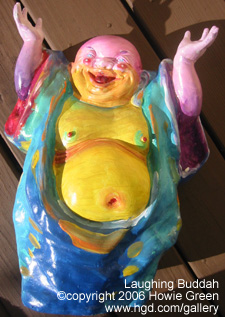 I've been musing that a person's sense of humor can serve as a marker for their other lines of development: mental, emotional, spiritual, ethical, etc. I'll get back to that in another post. But while researching levels of humor, I stumbled upon "Bullies to Buddies" an amazing site offering a book about how to stop childhood bullying.
To anyone with children I highly recommend chapter 5 on protecting the victim with "four magic words."
I also recommend to everyone Chapter 9 about humor as violence vs. humor as courage. Author Izzy Kalman MS argues that the Columbine high school massacre can be seen as a failure of the sense of humor of the children being bullied!
[Photo permission pending. Do click the image for a very funny gallery of painted images.]
Saturday, February 14, 2009
Meeting Karen Armstrong at Sacred Circles
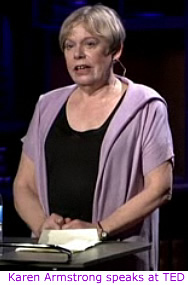 I'll confess that the main reason I went to the Sacred Circles conference at Washington's National Cathedral last night was to meet ground-breaking religious Historian Karen Armstrong (History of God, Battle for God, Spiral Staircase). But the evening would have been memorable even if the universe hadn't conspired to make my dream come true.
The annual woman's interfaith event drew perhaps 600 women for the theme "Love in Action," and Armstrong was the keynote speaker calling for all world religions to recognize compassion as their common root.
A really real cathedral
The soaring cathedral took my breath away. I had forgotten that this is a really real Cathedral which was perhaps shown off to its best by the contrast of classic stone pillars as backdrop for childrens' art and colorful displays from world religions. A portrait of First Lady and President Obama's inauguration day visit graced the entryway.
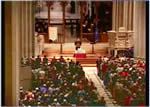 But it was the pageantry of the evening itself that most struck me. And I have to say that my appreciation was heightened ten-fold by a conversation I had a few hours earlier with my fellow Ken Wilber fan James Jones of the Personal Awareness Institute. James knows everybody and everything in personal and spiritual growth. He had just been telling me over coffee that all religious rituals can be identified with one or more of the levels of consciousness described in Spiral Dynamics (similar to the chakra system).
- from the archaic level, use of the body
- from the magic level, recognition of good and bad forces
- from the power level, sacrifice for protection from enemies
- from the mythic level, joining with God in an agreement to work together
- from the higher levels, calling forth God from within ourselves
Next came Anglican scholar Esther de Waal wearing black and gold with a necklace that appeared to be a large iron cross. In a formidable Teutonic voice she called forth the Celtic gods. (I am mis-remembering some of the theologic details, but you get the idea.) And finally came a beautiful bald woman in dangling, red earings and cream-colored robes that appeared Buddhist but for the starburst on the back. This was Rabbi Phyllis Berman who told us she lost her hair as a young person because of an allergy. After 20 years of hiding under a wig, she learned that facing the world as she is brought her the gift of being able to see others as they are, as well. With a radiant smile she led us in a Hebrew chant she translated as "Expand the boundaries of my tent."
Walking up the chakras
I felt exactly as if I had just walked up the chakras --except, of course, for intellect, the hole filled by Karen Armstrong. She told us of her project with TED to create a worldwide charter for compassion. And she told us of her journey: from failed nun, to producer of British TV shows that mocked religion, to time in the silence that drew her to study the monotheist tradition in a whole new way--from within its own perspective. She said that when she studied the prophet Mohammad, she worked to see the world through his eyes. As a result, she began to see all people with more compassion. And that's where I wanted to stand up and shout, because that was exactly my experience in the two-year dialogue with a fundamentalist bishop that led to my book.
The final speaker was an elfin Muslim woman from Afghanistan. Peeking out from a softly flowered headscarf, Sakena Yacoobi told of facing death threats and armed blockades to bring education to girls in her country. Her story reminded me of the thrilling and amazing book "Three Cups of Tea" which tells the similar adventure of an American man overtaken by desire to provide education to Afghani girls. I was struck by the difference that the miracles he achieved appear secular while Sakena credited God for hers.
Not a blessing, just a wish
Just before the evening ended, Armstrong got up to scuttle out a side door--the door that I was sitting beside. I stood, smiled, and reached out the postcard that desceibes my project. She took it and paused just long enough for me to tell her that she had inspired me and that I would love to have her blessing. "I don't do blessings," she said. "but I will wish you well on your spiritual journey." And with that, she gave me a hug, and she was off.
Saturday, February 7, 2009
93% of Muslims Condemn 9/11
The first worldwide Gallup poll of Muslims last year is reviewed by my favorite imam at his Minaret of Freedom blog. Here is the part that everybody needs to know.
Those who condemned the 9/11 attacks did so on specifically religious grounds: that the Qur’an forbids killing innocents and that murder is hated by God. Those who condoned the attacks did so on political grounds, charging the American government with imposing dictatorships and occupation on the Muslim world.Why wasn't this in the headlines? Did I miss it? I am not into the political stuff, but this supports my sense that the problem is not primarily the fact that some people take their holy books literally.
Thursday, January 22, 2009
Black Pastor's take on Obama Confounds Party Lines
A bracing sermon given by my book's co-author, Bishop Phil Thomas, on the Sunday before the inauguration of President Obama.
Bishop Thomas has never been one for the niceties of political correctness, but I love the sweet & sour way he mixes in-your-face truth with calls for peacemaking dialogue. My blogging buddy Karl argues that a true transpartisan is one who is willing to make both sides mad. This might fit the bill.
Bishop Thomas has never been one for the niceties of political correctness, but I love the sweet & sour way he mixes in-your-face truth with calls for peacemaking dialogue. My blogging buddy Karl argues that a true transpartisan is one who is willing to make both sides mad. This might fit the bill.
Thursday, December 11, 2008
Calling All Bodhisattvas
Why no apology to liberals?
Karl is right to ask me why I seem fixated here on apology to conservatives and those with traditional religious beliefs and not to liberals and those who have fled traditional belief to the next level of orange rationality and green pluralism.
SO GLAD YOU ASKED.
It's true that everybody deserves an apology because every position in religion and politics gets skewed, skewered, and vilified by its opposite side. And I have done my share of skewering in my lifetime and still do some in my heart.
And I want to make it plain that I understand and sympathize with every grievance against blue: shadows of judgment, hypocrisy, shame, and exclusion of outsiders. However,
Thus, because healthy green is theoretically capable of valuing blue, I'm calling them up on their tiptoes--into yellow--to do so. It was David Zeitler of Integral Institute who, in reading a draft chapter of my book, first interpreted it as a Bodhisattva call: A call to forgo the ego pleasures of putting down blue, put on the spiritual body armor that permits us to stand calmly in the face of being told we're going to hell, and lend a sympathetic ear to blue. In fact, not just lend an ear, but go back down to stand among them and acknowledge their professed highest value to love our neighbor as ourself. Acknowledge it, model it, draw it forth, and perhaps even learn it better ourselves.
Take a fundamentalist to lunch
A secular friend of mine reported this remark from her colleague who is a traditional Christian.
P.S. For a hoot, see potential illustrations of bodihisattva spiritual warriors:
a blue one, a green one, a yellow one and one that uncomfortably reminds me of myself--while I go ask permission to use them.
Karl is right to ask me why I seem fixated here on apology to conservatives and those with traditional religious beliefs and not to liberals and those who have fled traditional belief to the next level of orange rationality and green pluralism.
SO GLAD YOU ASKED.
It's true that everybody deserves an apology because every position in religion and politics gets skewed, skewered, and vilified by its opposite side. And I have done my share of skewering in my lifetime and still do some in my heart.
And I want to make it plain that I understand and sympathize with every grievance against blue: shadows of judgment, hypocrisy, shame, and exclusion of outsiders. However,
- The responsibility is to those who CAN
- Green can see blue better than blue can see green
(Orange gets a pass because they're still so fresh from breaking free of blue that they can't see its good side.) - Attacks from orange and green are not only unleashing pre-existing red, but also pressuring blue and even some orange to regress to red. This is the world problem I seek to solve. Two examples:
- The London subway bombers were doctors and lawyers highly respected in their communities for their good works with the poor
- Moral Majority founder Jerry Fallwell opposed the preaching of politics from the pulpit until school prayer was outlawed. I "voted" for that at the time, but now I think it was a sleeping dog we should have let lie. Choose your battles!
Thus, because healthy green is theoretically capable of valuing blue, I'm calling them up on their tiptoes--into yellow--to do so. It was David Zeitler of Integral Institute who, in reading a draft chapter of my book, first interpreted it as a Bodhisattva call: A call to forgo the ego pleasures of putting down blue, put on the spiritual body armor that permits us to stand calmly in the face of being told we're going to hell, and lend a sympathetic ear to blue. In fact, not just lend an ear, but go back down to stand among them and acknowledge their professed highest value to love our neighbor as ourself. Acknowledge it, model it, draw it forth, and perhaps even learn it better ourselves.
Take a fundamentalist to lunch
A secular friend of mine reported this remark from her colleague who is a traditional Christian.
I have several people in my social and business circles who are secularists. But I'll bet you have no traditional Christian friends and no knowledge of who the Christians are in your professional life.I seek to open this up a bit. Take a fundamentalist to lunch. (For inspiration, see my post on A Black Man who Befriended the Klan.)
P.S. For a hoot, see potential illustrations of bodihisattva spiritual warriors:
a blue one, a green one, a yellow one and one that uncomfortably reminds me of myself--while I go ask permission to use them.
Tuesday, December 9, 2008
Beliefs Don't Matter
Are you out of your mind, Teri? you just spent 20 years learning from New Thought that you can "Change your thinking, change your life." What do you mean beliefs don't matter?
It's not the content of the belief, its the response to the belief that matters. That's what I witnessed in my two years living among a group of high-end fundamentalists.
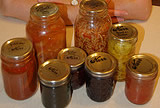 Let's say I believe the world will end through global warming. My neighbor believes the world will end when Jesus comes to slay non-believers and take believers to heaven. My response to my belief is to buy guns to fend off the hordes of beach dwellers I expect to swarm my upland property. My neighbor's response to her belief is to stock up canned goods and plan to share them with all comers in the last days.
Which one of us is more spiritually advanced?
Without getting into the distinctions between the ethical line, the spiritual line, and the congnitive line of development, I'll just say for myself, I'm glad she's my neighbor! (For fans of Ken Wilber, the four possible definitions of "spiritual" are on page 101 of "Integral Spirituality")
And yes, mythic beliefs are often correlated with ethnocentric behavior. But not always. And I believe that distinction is key to relieving some of our prejudices against each other and thus making room for new responses. It can often be easier to change a response than change a belief.
Change your response, change your life.
It's not the content of the belief, its the response to the belief that matters. That's what I witnessed in my two years living among a group of high-end fundamentalists.
Let's say I believe the world will end through global warming. My neighbor believes the world will end when Jesus comes to slay non-believers and take believers to heaven. My response to my belief is to buy guns to fend off the hordes of beach dwellers I expect to swarm my upland property. My neighbor's response to her belief is to stock up canned goods and plan to share them with all comers in the last days.Which one of us is more spiritually advanced?
Without getting into the distinctions between the ethical line, the spiritual line, and the congnitive line of development, I'll just say for myself, I'm glad she's my neighbor! (For fans of Ken Wilber, the four possible definitions of "spiritual" are on page 101 of "Integral Spirituality")
And yes, mythic beliefs are often correlated with ethnocentric behavior. But not always. And I believe that distinction is key to relieving some of our prejudices against each other and thus making room for new responses. It can often be easier to change a response than change a belief.
Change your response, change your life.
Photo from Southern Foodways Alliance.
Saturday, December 6, 2008
Why the Strange Book Title?
Update Sep 2009: The book has been retitled "The Bishop and the Seeker: Wrestling for the Soul of the 21st Century." We figure it will generate enough controversy even without an in-your-face-title.
Comparing "total depravity" to negative thinking
Some people have gotten the wrong impression from our draft book title, "Wicked and Evil Isn't That Bad: A Fundamentalist and a New Ager Wrestle for the Soul of the 21st Century." It definitely does not excuse evil or excuse those who use religion for intimidation.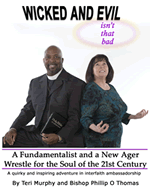
The phrase "Isn't that bad" refers to several themes that recur throughout the book. Teri learns that the view of salvation presented by Bishop Thomas isn't as bad as her preconceptions about it, and Bishop Thomas learns that the motives of most people in alternative religion aren't as selfish as many Christians believe. They even discuss how moral relativism isn't that bad--when it is practiced with an intention to seek the highest good of all. Bishop Thomas amazes Teri by claiming that Christians are the original moral relativists charged with promoting the spirit of the law over its letter. "All things are lawful, but not all things are expedient." he quotes from the New Testament.
Comparing "total depravity" to negative thinking
Some people have gotten the wrong impression from our draft book title, "Wicked and Evil Isn't That Bad: A Fundamentalist and a New Ager Wrestle for the Soul of the 21st Century." It definitely does not excuse evil or excuse those who use religion for intimidation.
The phrase "Isn't that bad" refers to several themes that recur throughout the book. Teri learns that the view of salvation presented by Bishop Thomas isn't as bad as her preconceptions about it, and Bishop Thomas learns that the motives of most people in alternative religion aren't as selfish as many Christians believe. They even discuss how moral relativism isn't that bad--when it is practiced with an intention to seek the highest good of all. Bishop Thomas amazes Teri by claiming that Christians are the original moral relativists charged with promoting the spirit of the law over its letter. "All things are lawful, but not all things are expedient." he quotes from the New Testament.
Then at one point half way through the book, Bishop Thomas tells a friend of Teri's that EVERYBODY is wicked and evil.
"That's sad!" the friend exclaims.
It takes a moment for Bishop to realize she means it's sad that he thinks that way. "No wait," he says. "Wicked and evil isn't that bad."
Everybody blinks in astonishment until Bishop T. explains that he sometimes uses "wicked and evil" to refer to the petty jealousies, judgments, and self-centeredness inside us all, even those of us who are outwardly compassionate. This doctrine of total depravity is a hopeful thing because it reminds us not to judge others, he says. And then he compares his doctrine to Teri's New Thought belief that everyone must guard against negative thoughts.
It is a moment that ruptures preconceptions on both sides, thus making way for something new.
Do you think it would be more clear if we changed the title to "Total Depravity Isn't That Bad"? Or how about, "A Fundamentalist and a New Ager Join Forces to Transcend Extreme Moral Relativism?"
Catchy, heh?
Monday, November 10, 2008
An Open Apology to Conservatives
Arrested for a McCain T shirt
I want to apologize personally to the many conservatives who are frightened by the video of a man arrested on election eve for wearing a McCain T shirt to an Obama celebration in South Philadelphia. I would be frightened too, if I were in your shoes. Even those conservatives who do not buy into the radical version of the Biblical End Times may have raised an eyebrow at this apparent fulfillment of the prophecy that Christians will be arrested as a first step.
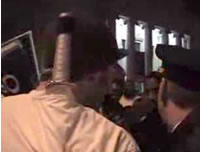 If this video were only as it appears to be, it would be a travesty. However, if you watch the longer version it becomes clear that the young man set up the situation intentionally and exacerbated it by wearing a toy dagger protruding from the back of his T shirt. Also note that Philadelphia has a history of street violence such that police had reason to be nervous as crowds filled the streets.
Mutual fear
Nevertheless, this incident is most unfortunate and bespeaks a deeper issue--the fear of each other by many liberals and conservatives. Many postmodern liberals treat conservatives with a disdain that conservatives have every right to be offended by. I know because I was one of those postmoderns (though never with the label of liberal; see Why I am a Recovering Libertarian.) First I lumped all conservatives together--not noticing the huge range in intellectual, ethical, and theological orientation. And then I thought that anyone who took the Bible literally was either ignorant or immature. But when circumstances dropped me into an unusual fundamentalist church, my experience actually living among the fundamentalists for two years changed all that. I came to respect their love and their passionate committment to a better world for all through what they called "The Kingdom of God."
Of course, many of my friends have had very different experiences with orthodox Christian churches. A gentle friend told me yesterday how for her, the fear has lifted for the first time in her life since the election. "It took me several days to feel the full effect as I found myself walking taller," this older woman said. She has spent many years in personal and spiritual growth work learning forgiveness and nonjudgment for her rigid Christian upbringing. I truly believe if she had been there that night, she would have reached out an arm to the young man with the T shirt and invited him to join the party--her and female partner.
What will it take for all of us to move to this kind of reponse to each other?
I want to apologize personally to the many conservatives who are frightened by the video of a man arrested on election eve for wearing a McCain T shirt to an Obama celebration in South Philadelphia. I would be frightened too, if I were in your shoes. Even those conservatives who do not buy into the radical version of the Biblical End Times may have raised an eyebrow at this apparent fulfillment of the prophecy that Christians will be arrested as a first step.
If this video were only as it appears to be, it would be a travesty. However, if you watch the longer version it becomes clear that the young man set up the situation intentionally and exacerbated it by wearing a toy dagger protruding from the back of his T shirt. Also note that Philadelphia has a history of street violence such that police had reason to be nervous as crowds filled the streets.Mutual fear
Nevertheless, this incident is most unfortunate and bespeaks a deeper issue--the fear of each other by many liberals and conservatives. Many postmodern liberals treat conservatives with a disdain that conservatives have every right to be offended by. I know because I was one of those postmoderns (though never with the label of liberal; see Why I am a Recovering Libertarian.) First I lumped all conservatives together--not noticing the huge range in intellectual, ethical, and theological orientation. And then I thought that anyone who took the Bible literally was either ignorant or immature. But when circumstances dropped me into an unusual fundamentalist church, my experience actually living among the fundamentalists for two years changed all that. I came to respect their love and their passionate committment to a better world for all through what they called "The Kingdom of God."
Of course, many of my friends have had very different experiences with orthodox Christian churches. A gentle friend told me yesterday how for her, the fear has lifted for the first time in her life since the election. "It took me several days to feel the full effect as I found myself walking taller," this older woman said. She has spent many years in personal and spiritual growth work learning forgiveness and nonjudgment for her rigid Christian upbringing. I truly believe if she had been there that night, she would have reached out an arm to the young man with the T shirt and invited him to join the party--her and female partner.
What will it take for all of us to move to this kind of reponse to each other?
Friday, October 24, 2008
Transpartisan Values 2: Measuring Them
In Part 1 of this post I noted that Jonathan Haidt's "Real Difference Between Liberals and Conservatives" fueled my belief that conservative and liberal values converge as we mature, birthing integral transpartisans. If that's true, the historic opportunities of Obama's presidency require us to recognize this new animal. For starters, let's see how we might use data like Haidt's to identify integral conservatives.
Caveat 1: My Political Bias
To understand my bias, see my post Why I am a Recovering Libertarian.
Caveat 2: Fools Rush In
I don't know much about tests to measure your level of development; what I know is from a conference call in 2007 with David Zeitler of Integral Institute. My impression is that the available tests are big, complex, and expensive. So this post is a case of fools rushing in where the really smart guys advise caution.
Sorting most conservatives from most liberals
The questions in Haidt's Five Foundations survey are simplistic, but as such they are perfect for filtering most liberals from most conservatives. For the moment I'm going to go with Karl's assumption that most conservatives are at purple-red-blue-orange (in Spiral Dynamics), while most liberals are at blue-orange-green. But I also suspect that some liberals are lower while some conservatives are higher. And remember, according to Integral Theory, "higher" means having a broader perspective that encompasses more experience.
The preamble to all questions in Haidt's Five Foundations survey is, "When you decide whether something is right or wrong, to what extent are the following relevant to your thinking? " One of the questions asks "Whether or not someone showed a lack of respect for authority." It seems likely that
Human guniea pig: my own results on Haidt's survey
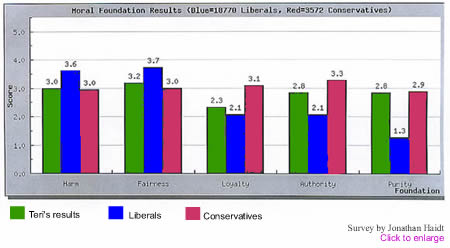
Considerations like these show up in my own test results shown in the chart below:
Screening for Transpartisans
How do we enhance a survey like Haidt's to make such a distinction? I think Karl is right (see his comment on my prior post); Each level has a primary value against which it filters or screens all other values. Thus, liberals at green or ornage screen out value on place on purity, loyalty, and sanctity to avoid any possible conflict with their primary values of fairness and protection from harm. Thus, our questions would need to screen for
Step 1: find the liberals who hold all five values
Our first test would use questions like those in Haidt's Five Foundations survey and simply pad them with qualifiers.
Step 2: Filter out the blue
Presumably we now have a pool of blue, yellow, and beyond. The next step is to sort out those at blue: those who will always prioritize purity, loyalty, and authority as predicted by the spiral, and those whose scope of care is less than worldcentric. This sorting so would require questions carefully designed to get at the motives or perspectives behind the answers.
If these two steps indeed filtered blue, orange, and green, I suspect they would also filter out most of those with a strong political identification as liberal or conservative. Those left will identify themselves politically as independent, libertarian, or "other." These are our potential transpartisans. And I believe that if you ask them how they identified themselves previously, you will get a mix of those who have transcended both "liberal" and "conservative" labels. (More about why/how in a future post.)
Know it when I see it
But the more I look at this, the more I realize the big boys are right: no test can sort the levels adequately--partly because nobody could be trusted to score it. For me it boils down to having conservative friends whose behavior over an extended period tells me they're at integral--or higher. They take big risks to prevent harm to people outside their ingroups; they agonize over questions of appropriate authority; and they realize that whatever form salvation comes in, it must be available to all.
Can we reach out a hand to these transpartisans whose path to integral may have been so different from our own?
Caveat 1: My Political Bias
To understand my bias, see my post Why I am a Recovering Libertarian.
Caveat 2: Fools Rush In
I don't know much about tests to measure your level of development; what I know is from a conference call in 2007 with David Zeitler of Integral Institute. My impression is that the available tests are big, complex, and expensive. So this post is a case of fools rushing in where the really smart guys advise caution.
Sorting most conservatives from most liberals
The questions in Haidt's Five Foundations survey are simplistic, but as such they are perfect for filtering most liberals from most conservatives. For the moment I'm going to go with Karl's assumption that most conservatives are at purple-red-blue-orange (in Spiral Dynamics), while most liberals are at blue-orange-green. But I also suspect that some liberals are lower while some conservatives are higher. And remember, according to Integral Theory, "higher" means having a broader perspective that encompasses more experience.
The preamble to all questions in Haidt's Five Foundations survey is, "When you decide whether something is right or wrong, to what extent are the following relevant to your thinking? " One of the questions asks "Whether or not someone showed a lack of respect for authority." It seems likely that
- A conservative at blue is going to choose "Very Relevant" fast enough to make your head spin.
- A liberal at green is going to be just as fast to choose "Not Very Relevant."
- But everybody else is going to pause. Any liberals at the conventional level may well think, Most conservatives respect authority too much; I don't want to be associated with conservatives, so I will downshift my answer a notch or two, perhaps to "slightly relevant."
- And anyone at the yellow level or above is going to start asking questions about the context.
- Is it a legitimate authority?
- Did the authority violate its trust?
- Were all respectful options exhausted?
- Was the system itself at risk of harm?
Human guniea pig: my own results on Haidt's survey
Considerations like these show up in my own test results shown in the chart below:
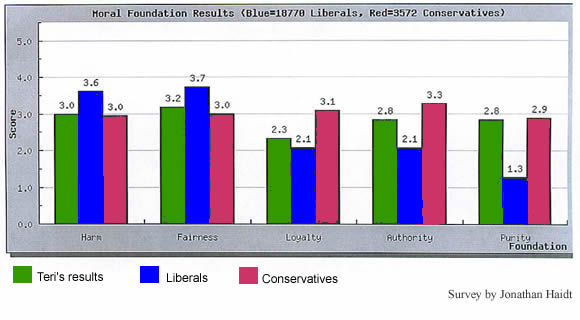
- With liberals, I ranked low on loyalty. (I'd only die for my country if I thought we were protecting someone from harm)
- With conservatives I ranked high on purity/sanctity. But I'm a libertarian on purity (e.g., not only are laws against homosexuality wrong, but laws against drugs and prostitution are wrong, too). So what's up with that ranking? Could it be the hour I spent trying to decide my answer to the weight on "what God wants"? (For more on purity and sanctity, see my One chart that Explains Religion.)
- With conservatives I ranked a bit lower than liberals on harm and fairness. Regarding harm, I can remember the exact day I down-shifted. Someone had to be removed from a team to keep from holding the team back. I agonized over the decision as someone I respected said, "I see why you have to do this, but she will be hurt." I did it anyway and hoped I never had to make a decision like that again.
- On respect for authority, I ranked half way between the liberals and conservatives, perhaps largely because of the experience I just mentioned
Screening for Transpartisans
How do we enhance a survey like Haidt's to make such a distinction? I think Karl is right (see his comment on my prior post); Each level has a primary value against which it filters or screens all other values. Thus, liberals at green or ornage screen out value on place on purity, loyalty, and sanctity to avoid any possible conflict with their primary values of fairness and protection from harm. Thus, our questions would need to screen for
- the person's primary ethical value (e.g., those for whom fairness and care always trump purity, loyalty, and authority.)
- the scope of the ingroup to which loyalty, fairness, and care are applied (family, tribe, or world)
Step 1: find the liberals who hold all five values
Our first test would use questions like those in Haidt's Five Foundations survey and simply pad them with qualifiers.
- A generic qualifier at the start that would reassure the libertarians that "These questions do not concern the passing of laws or use of punishment. They deal solely with how you personally feel about what is right and wrong."
- A qualifier specific to each question for anyone at post conventional, e.g., "In a situation in which you personally believe that someone showed a lack of respect for legitimate authority..."
Step 2: Filter out the blue
Presumably we now have a pool of blue, yellow, and beyond. The next step is to sort out those at blue: those who will always prioritize purity, loyalty, and authority as predicted by the spiral, and those whose scope of care is less than worldcentric. This sorting so would require questions carefully designed to get at the motives or perspectives behind the answers.
If these two steps indeed filtered blue, orange, and green, I suspect they would also filter out most of those with a strong political identification as liberal or conservative. Those left will identify themselves politically as independent, libertarian, or "other." These are our potential transpartisans. And I believe that if you ask them how they identified themselves previously, you will get a mix of those who have transcended both "liberal" and "conservative" labels. (More about why/how in a future post.)
Know it when I see it
But the more I look at this, the more I realize the big boys are right: no test can sort the levels adequately--partly because nobody could be trusted to score it. For me it boils down to having conservative friends whose behavior over an extended period tells me they're at integral--or higher. They take big risks to prevent harm to people outside their ingroups; they agonize over questions of appropriate authority; and they realize that whatever form salvation comes in, it must be available to all.
Can we reach out a hand to these transpartisans whose path to integral may have been so different from our own?
Tuesday, October 21, 2008
Transpartisan Values 1: Liberal and Conservative?
You know how it is when you leave a partner or a paradigm behind, you focus on everything that was wrong with it? I have a suspicion that's what's at work for many of us when we outgrow and turn against values we were raised with—like loyalty to our ingroup. Integral Theory tells me there are higher levels at which we re-integrate those values; we transcend and include them. And I believe that when we get to those levels, former "liberals" and "conservatives" will meet up as integral transpartisans.
Five universal values
I got a new way to think about this in Jonathan Haidt's "The Real Difference between Liberals and Conservatives." In his TED video, the social psychologist tells his mostly liberal audience they could achieve more of their agenda if they'd drop some of their prejudices against conservatives. Unfortunately his talk introduces his findings in a way that could be offensive to conservatives, thus diluting his effectiveness. But his message is clear in the paper in which he defends his "Five Foundations Theory." It claims that five values undergrid the world's many moralities, but liberals and conservatives emphasize the values differently.
He says liberals and conservatives value these two about equally
Beyond Merely Acknowledging Conservative Values
I can hear most of my integral buddies saying, "OK, fine, conservatives have ethical values. But Spiral Dynamics shows us they are low-end ethics." And that's half true. But mapping Haidt's data against the spiral makes it clearer than ever to me why we must reintegrate those "conservative" values as we reach the higher levels. Haidt implies this by asking, "Why has the moral domain shrunk for educated secular Westerners?" Instead of merely transcending and tolerating conservative values, we must also find a way to include them.
Research indeed backs up the liberal feeling that some conservatives' ethics are lower. (An integral perspective tells us that a "higher" value is one with a bigger perspective—it takes more into account.) In Kohlberg's famous stages of development, purity, respect for authority, and loyalty arise in the early stages (pre-conventional and conventional), while care and fairness arise in the later post-conventional stages. [Update: Whoops, that last clause is wrong, as pointed out in Karl's comment below. Care & fairness emerge early. But they are weak until post-conventional because they are overshadowed by the primary values at the lower levels, and they are applied only to one's ingroup.] Thus Haidt asks whether the three conservative values are "just manifestations of Kolhberg's 'immature' conventional morality stages." If we look through the lens of an integral perspective, the answer is "yes" in the lower stages but "maybe not" as we approach the top.
One of Integral's best tools is Spiral Dynamics, a scheme which elaborates on Kohlberg's stages with the insight that values emerge in a natural progression that loops from concern for the individual to concern for the group. Haidt's five values map perfectly to the Spiral levels as shown below.
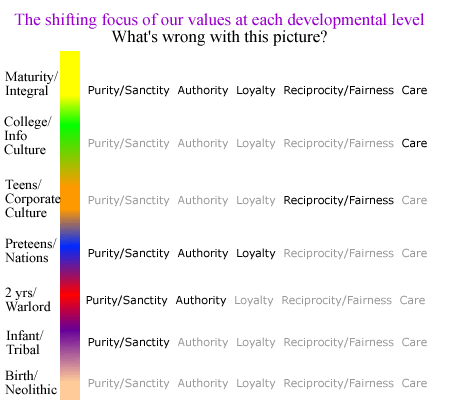
(The grayed values are inactive, and the line of grayed values at the bottom level represents my inclination to go along with Haidt's claim that we are born with a "taste bud" for these values. This contradicts Spiral Dynamics' claim that values emerge from experience. But it's my chart, so I'm going out on that limb.)
At first glance at this chart, liberals may be tempted to say, "See, our orange/green values are higher than conservatives' red/blue values." For even when blues try to be good Samaritans, providing care to an outgroup, they can only provide the kind of care they themselves would want. It's not till green that we can take another's perspective--love our neighbor as ourselves.
But look closely and notice what happens at the orange level of teens, corporate culture, and the Enlightenment. Up until this level, the values have been coming into focus and staying in focus. But Haidt's findings seem to suggest that the teenager now breaks with convention, rejects the first-flowering values of purity/sanctity, authority, and loyalty, and he or she substitutes the new values of reciprocity/fairness and then care/protection from harm. We feel we have transcended the "lower" values. In the case of loyalty, for example, we shift our loyalty from our ingroup to all humans, or to an ideal, or even to ourselves, recasting it as "to thine own self be true." "Loyalty" feels outdated.
Integrating all five at the high end
But notice the yellow "integral" level at the top of the chart. This is the level at which we integrate the values of all prior levels. This is the level at which we reclaim the previously transcended values. We see that authority, loyalty, purity, and sanctity have a rightful place in higher level morality and we want them back.
We'll know we have thus transcended and included each of these values when we can consciously choose among them from a broader perspective. Indications that we are at this level include
So who holds all five values?
If people at the upper level weigh all five values, why doesn't Haidt's research show any liberals holding all five values? I can see three reasons.
Distinguishing high level values from low level
The problem is, it can be impossible to tell the difference between someone acting at a higher level (with a broader perspective) and someone at a less mature level.
Let's take, for example, Sarah Palin's demotion of her state trooper brother-in-law. From the publicly available details, it appears Palin chose loyalty over reciprocity and even over respect for authority. Most everyone will agree that would be wrong and extremely dangerous in a public leader. But if you are a conservative pre-disposed to like Palin, you may look for evidence there were extenuating circumstances such that she did what she felt she had to do to protect her family from imminent harm. On the other hand, if you are a liberal pre-disposed to dislike Palin, you are more likely to assume she acted from the shadow side of loyalty, taking revenge into her own hands. From the outside, those two acts look the same.
And that's what's wrong with so much religious and political debate today. We assume the highest motives for our side and assume the lowest for the other side. What could happen if we flipped that script—checking ourselves for lower motives while giving our opponent the benefit of the doubt about theirs? My experience shows that the release of pressure we get when we do so creates space for something new to happen.
Haidt seems to agree.
Five universal values
I got a new way to think about this in Jonathan Haidt's "The Real Difference between Liberals and Conservatives." In his TED video, the social psychologist tells his mostly liberal audience they could achieve more of their agenda if they'd drop some of their prejudices against conservatives. Unfortunately his talk introduces his findings in a way that could be offensive to conservatives, thus diluting his effectiveness. But his message is clear in the paper in which he defends his "Five Foundations Theory." It claims that five values undergrid the world's many moralities, but liberals and conservatives emphasize the values differently.
He says liberals and conservatives value these two about equally
- Care/Protection from Harm
- Reciprocity/Fairness
- Authority/Respect
- Loyalty/Ingroup
- Purity/Sanctity
We in psychology, and in academe more generally, have a tendency to reject conservative concerns related to ingroup, authority, and purity as "bad" on the grounds that they often conflict with the "good" moralities of harm and fairness. We dismiss the conservative outgroup's morality as "motivated social cognition" driven by non-moral concerns such as fear of change. Doing so makes us feel good, but it should not, for it is a violation of our values (we become "politico-centric"), and it is a route to irrelevance (we cannot persuade the electorate, because we do not have an accurate picture of their moral motivations)...I can say a loud "Amen" based on my experience living among the fundamentalists for two years. When I worked hard to understand their concerns about homosexuality, the result was a willingness to drop their support of gay marriage bans—because, "Judgment is up to God, not the government." While this outcome is not wholly satisfactory to many, the question is, would you rather make progress like this or is it more important to keep proving how wrong the other side is?
[For example] Conservatives and many moderates are opposed to gay marriage in part due to moral intuitions related to ingroup, authority, and purity, and these concerns should be addressed, rather than dismissed contemptuously... Recognizing these foundations as moral (instead of amoral, immoral, or just plain stupid) can open a door in the wall that separates liberals and conservatives when they try to discuss moral issues.
Beyond Merely Acknowledging Conservative Values
I can hear most of my integral buddies saying, "OK, fine, conservatives have ethical values. But Spiral Dynamics shows us they are low-end ethics." And that's half true. But mapping Haidt's data against the spiral makes it clearer than ever to me why we must reintegrate those "conservative" values as we reach the higher levels. Haidt implies this by asking, "Why has the moral domain shrunk for educated secular Westerners?" Instead of merely transcending and tolerating conservative values, we must also find a way to include them.
Research indeed backs up the liberal feeling that some conservatives' ethics are lower. (An integral perspective tells us that a "higher" value is one with a bigger perspective—it takes more into account.) In Kohlberg's famous stages of development, purity, respect for authority, and loyalty arise in the early stages (pre-conventional and conventional), while care and fairness arise in the later post-conventional stages. [Update: Whoops, that last clause is wrong, as pointed out in Karl's comment below. Care & fairness emerge early. But they are weak until post-conventional because they are overshadowed by the primary values at the lower levels, and they are applied only to one's ingroup.] Thus Haidt asks whether the three conservative values are "just manifestations of Kolhberg's 'immature' conventional morality stages." If we look through the lens of an integral perspective, the answer is "yes" in the lower stages but "maybe not" as we approach the top.
One of Integral's best tools is Spiral Dynamics, a scheme which elaborates on Kohlberg's stages with the insight that values emerge in a natural progression that loops from concern for the individual to concern for the group. Haidt's five values map perfectly to the Spiral levels as shown below.
(The grayed values are inactive, and the line of grayed values at the bottom level represents my inclination to go along with Haidt's claim that we are born with a "taste bud" for these values. This contradicts Spiral Dynamics' claim that values emerge from experience. But it's my chart, so I'm going out on that limb.)
At first glance at this chart, liberals may be tempted to say, "See, our orange/green values are higher than conservatives' red/blue values." For even when blues try to be good Samaritans, providing care to an outgroup, they can only provide the kind of care they themselves would want. It's not till green that we can take another's perspective--love our neighbor as ourselves.
But look closely and notice what happens at the orange level of teens, corporate culture, and the Enlightenment. Up until this level, the values have been coming into focus and staying in focus. But Haidt's findings seem to suggest that the teenager now breaks with convention, rejects the first-flowering values of purity/sanctity, authority, and loyalty, and he or she substitutes the new values of reciprocity/fairness and then care/protection from harm. We feel we have transcended the "lower" values. In the case of loyalty, for example, we shift our loyalty from our ingroup to all humans, or to an ideal, or even to ourselves, recasting it as "to thine own self be true." "Loyalty" feels outdated.
Integrating all five at the high end
But notice the yellow "integral" level at the top of the chart. This is the level at which we integrate the values of all prior levels. This is the level at which we reclaim the previously transcended values. We see that authority, loyalty, purity, and sanctity have a rightful place in higher level morality and we want them back.
We'll know we have thus transcended and included each of these values when we can consciously choose among them from a broader perspective. Indications that we are at this level include
- We are not knee-jerk controlled by any one value
- We are passionately for each value without being against the others
- We can access each value when appropriate
- We avoid extremes by integrating opposites: For just as too much loyalty breeds revenge, we come to see that too much reciprocity breeds heartless legalism and too much care breeds what Buddhists call idiot compassion.
- We are not 100% sure we are right but we are willing to make tough choices in full humility that we may be wrong
- We loosen identity with a political party, seeking to become transpartisan
So who holds all five values?
If people at the upper level weigh all five values, why doesn't Haidt's research show any liberals holding all five values? I can see three reasons.
- Haidt's questions aren't designed to sniff out the distinctions in the list above. So a person at the integral level who weighs loyalty to family against loyalty to every other human being may not test out as being "loyal" at all (see Karl's fantastic comment below)
- Haidt apparently drops data from those who identify themselves as "independents," "libertarians," or "other," and those are exactly the categories in which the integral transpartisans may be hiding out
- Ethical values are only a subset of the values that distinguish conservatives from liberals, and those labels don't take into account variation within the two camps--as identified in my One Chart that Explains all Politics
Distinguishing high level values from low level
The problem is, it can be impossible to tell the difference between someone acting at a higher level (with a broader perspective) and someone at a less mature level.
Let's take, for example, Sarah Palin's demotion of her state trooper brother-in-law. From the publicly available details, it appears Palin chose loyalty over reciprocity and even over respect for authority. Most everyone will agree that would be wrong and extremely dangerous in a public leader. But if you are a conservative pre-disposed to like Palin, you may look for evidence there were extenuating circumstances such that she did what she felt she had to do to protect her family from imminent harm. On the other hand, if you are a liberal pre-disposed to dislike Palin, you are more likely to assume she acted from the shadow side of loyalty, taking revenge into her own hands. From the outside, those two acts look the same.
And that's what's wrong with so much religious and political debate today. We assume the highest motives for our side and assume the lowest for the other side. What could happen if we flipped that script—checking ourselves for lower motives while giving our opponent the benefit of the doubt about theirs? My experience shows that the release of pressure we get when we do so creates space for something new to happen.
Haidt seems to agree.
Social justice researchers might benefit from stepping out of the"good versus evil" mindset that is often present in our conferences, our academic publications, and our private conversations. One psychological universal (part of the ingroup foundation) is that when you call someone evil you erect a protective moral wall between yourself and the other, and this wall prevents you from seeing or respecting the other's point of view.My next post will kick around the kinds of survey questions that could distinguish integral transpartians who truly weigh all five values from those conservatives who see themselves as attempting to do so but who always end up privileging the earlier values over the later ones. And I'll be asking for your help. Take a moment to subscribe below so you won't miss a thing.
It's more entertaining to watch people throw rocks at each other over the wall than it is to watch the slow, difficult process of dismantling the wall...
Friday, October 17, 2008
One Chart that Explains Politics
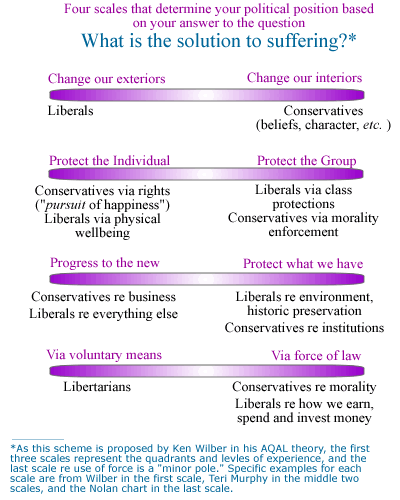
This chart attemps to integrate insights from Ken Wilber's AQAL Theory and David Nolan's Nolan chart. It is a work-in-progress with comments appreciated.
But how does it relate to spirituality and the Purity/Sanctity values identified by Haidt? Just take the top scale, Interiors/Exteriors, and turn it horizontally, heavanward, as in my One Chart that Explains Religion.
Thursday, October 16, 2008
One Chart that Explains Religion
(as it relates to politics)
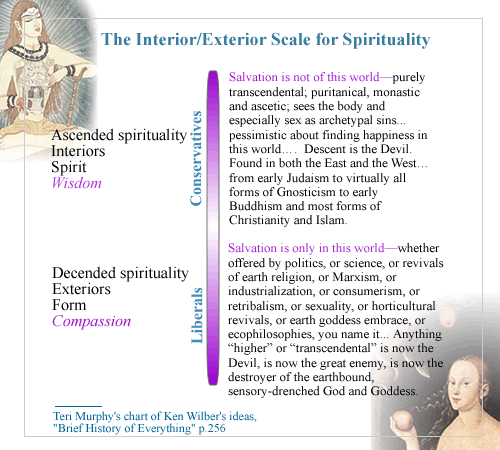 As I hinted in my post on Jonathan Haidt's "The Real Difference between Liberals and Conservatives," this chart goes a long way toward explaining Haidt's results for purity and sanctity in his survey of the five foundation of morality. In the modern world, the values of purity and sanctity that belong at the top of the chart have been transcended by the authenticity and "whatever feels good do it" ethos at the bottom. This creates the political fights over prayer in schools, Christmas creches, and sexuality laws from the ascenders and over food & environmental regulations from the descenders.
The chart is based in Ken Wilber's insight that the only reliable marker for conservatives and liberals is that conservatives favor interior solutions to suffering and liberals favor exterior solutions. (See my One Chart that Explains all Politics). Superimpose that idea over his concept that we all have a "god" or idea of salvation. He calls these the gods of the "ascending" and "descending" paths.
Wisdom vs. compassion
I personally felt a major breakthrough in dealing with the tension between these two paths when Wilber explained their respective merits. He calls the path of ascent “the path of wisdom” because it sees that behind all the forms there lies,
When I shared this concept of ascending and descending religion with my favorite fundamentalist, he said, "Oh yeah. That's the horizontal axis and the vertical axis of the cross. It's the job of any good church to balance these two."
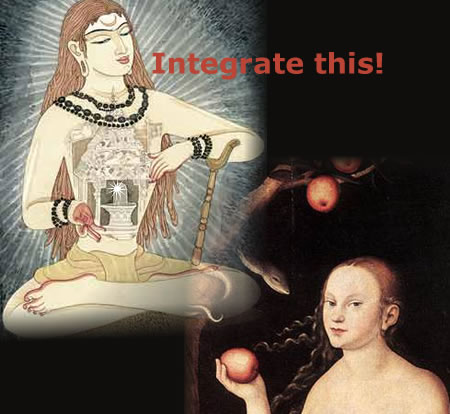
PS: Coincidence...?
I was enjoying creating the graphic above, playing with the fade between the two images, when suddenly the aescetic's walking stick seemed to spurt from Eve's tree. Woo oooh oooh as we used to say in my more New Agey days.
The chart is based in Ken Wilber's insight that the only reliable marker for conservatives and liberals is that conservatives favor interior solutions to suffering and liberals favor exterior solutions. (See my One Chart that Explains all Politics). Superimpose that idea over his concept that we all have a "god" or idea of salvation. He calls these the gods of the "ascending" and "descending" paths.
Wisdom vs. compassion
I personally felt a major breakthrough in dealing with the tension between these two paths when Wilber explained their respective merits. He calls the path of ascent “the path of wisdom” because it sees that behind all the forms there lies,
The One, the good, the unqualifiable Emptiness, against which all forms are seen to be illusory, fleeting, impermanent… Wisdom is the return of the Many to the One.My argument is that one way for us postmoderns to find more wisdom is by appropriately including the purity and sanctity we have transcended. As one potential example, a Sierra Club article argues that if environmentalists want to win over conservatives, they must recast their vision as honoring the sacredness of creation. But it can't just be a spin. It has to be a real vision shift.
The path of descent, on the other hand, is the path of compassion. It sees that the One actually manifests as the Many, and so all forms are to be treated equally with kindness, compassion, mercy. … it found its glory in the celebration of diversity. Not greater oneness, but greater variety was the goal of this God... It is a religion of great compassion, little wisdom.
When I shared this concept of ascending and descending religion with my favorite fundamentalist, he said, "Oh yeah. That's the horizontal axis and the vertical axis of the cross. It's the job of any good church to balance these two."
PS: Coincidence...?
I was enjoying creating the graphic above, playing with the fade between the two images, when suddenly the aescetic's walking stick seemed to spurt from Eve's tree. Woo oooh oooh as we used to say in my more New Agey days.
Wednesday, October 15, 2008
Amazing Abortion Debate: How to Change Minds
Last night I took part in a church discussion about abortion that was passionate and intense without being confrontational. I'm quite sure opinions shifted--including my own.
I dropped by a Bible study at the Fundamentalist church where I am still a member (while also a member of an interfaith church). Bishop Thomas opened by saying that last week he told his congregation they should not be misled to vote in the upcoming Obama/McCain election based on the single issue of abortion; the array of moral issues to be considered is much broader, he said. Then he invited up a woman who had quietly challenged him after that meeting. She was to be allowed to present the other side of the abortion argument. We'll call her Celia.
Hearing Both Sides
With good cheer and 20 minutes of PowerPoints, Celia walked us through the various techniques of abortion and several scriptures about God knowing us when we were in the womb. Then she asked, seemingly rhetorically, if abortion was always wrong, always murder. The 30 or so people dispersed in wooden pews murmured assent, though I sensed tension in the room. One man said, "Killing is not always murder--not if somebody breaks into my house."
Bishop Thomas jumped in to agree. Every killing isn't murder, he said. There is "a time to kill" in scripture. Abortion for "mere convenience" is murder, but cases of health of the mother may not be.
Celia flipped to her next slide which asked, "Suppose you had a condition which gave a 95% chance you would die in childbirth. Would you abort the child?" A tense pause was broken by a woman who said, "You're damned if you do and damned if you don't." Then several people--men and women--raised their hands to say they would not abort. They would trust God to select the outcome. But a few others began to raise their hands to speak on behalf of women who might be victims of rape or incest. They said no one could judge anyone else for a choice like that, especially when needs of a woman's other children were considered. Celia maintained her stand that abortion is always murder. That's when I raised my hand.
A Surprise Video
"But I've got to show you one more thing," Celia exclaimed. And then she showed a video of a TV news report. It was a story about a woman who was told 20 years ago that she would die in childbirth, but she went ahead and gave birth to a healthy baby. The reporters interviewed her bright, handsome son as he ran the track at his school, 20 years later. And then Celia called up that same young man from among us in the pews. "I was that woman," she proclaimed. The young man came to stand proudly by her side, along with his father. Everyone leapt to their feet and cheered--including me.
But as the cheering subsided, a woman in the back said, "But I have a friend who took the same chance and died."
Then Bishop Thomas jumped in as if he could contain himself no longer. He said something like this.
A woman stood and declared what a blessing it was to be able to argue about topics like this in a respectful atmosphere. Bishop Thomas quoted Peter, "Always be ready to give an answer for the hope that is in you, but do so with gentleness and respect."
Afterwards the woman who made the comment about "Damned if you do" came up to me and said,"We didn't even get to the part about how just because abortion isn't a choice we would make, that doesn't mean we would force it on other people. We can't expect them to live to our standards."
I think we all went home that night feeling bigger.
I dropped by a Bible study at the Fundamentalist church where I am still a member (while also a member of an interfaith church). Bishop Thomas opened by saying that last week he told his congregation they should not be misled to vote in the upcoming Obama/McCain election based on the single issue of abortion; the array of moral issues to be considered is much broader, he said. Then he invited up a woman who had quietly challenged him after that meeting. She was to be allowed to present the other side of the abortion argument. We'll call her Celia.
Hearing Both Sides
With good cheer and 20 minutes of PowerPoints, Celia walked us through the various techniques of abortion and several scriptures about God knowing us when we were in the womb. Then she asked, seemingly rhetorically, if abortion was always wrong, always murder. The 30 or so people dispersed in wooden pews murmured assent, though I sensed tension in the room. One man said, "Killing is not always murder--not if somebody breaks into my house."
Bishop Thomas jumped in to agree. Every killing isn't murder, he said. There is "a time to kill" in scripture. Abortion for "mere convenience" is murder, but cases of health of the mother may not be.
Celia flipped to her next slide which asked, "Suppose you had a condition which gave a 95% chance you would die in childbirth. Would you abort the child?" A tense pause was broken by a woman who said, "You're damned if you do and damned if you don't." Then several people--men and women--raised their hands to say they would not abort. They would trust God to select the outcome. But a few others began to raise their hands to speak on behalf of women who might be victims of rape or incest. They said no one could judge anyone else for a choice like that, especially when needs of a woman's other children were considered. Celia maintained her stand that abortion is always murder. That's when I raised my hand.
"I want to get back to the point about being damned if you do and damned if you don't'" I said. "If you believe you are saved, you know you aren't damned either way."A long silence was followed by more people telling what they would do. I was struck by the number of women who said they would risk their own lives rather than abort.
"That's right," Bishop Thomas interjected.
"When I had my abortion, I knew it was killing--and if you want to call it murder, that's fine, too. I told God I did what I had to do, and I needed him to work with me on it. In the same situation I would do it again today--though I would do everything in my power to prevent the situation from happening again."
A Surprise Video
"But I've got to show you one more thing," Celia exclaimed. And then she showed a video of a TV news report. It was a story about a woman who was told 20 years ago that she would die in childbirth, but she went ahead and gave birth to a healthy baby. The reporters interviewed her bright, handsome son as he ran the track at his school, 20 years later. And then Celia called up that same young man from among us in the pews. "I was that woman," she proclaimed. The young man came to stand proudly by her side, along with his father. Everyone leapt to their feet and cheered--including me.
But as the cheering subsided, a woman in the back said, "But I have a friend who took the same chance and died."
Then Bishop Thomas jumped in as if he could contain himself no longer. He said something like this.
"Celia, that's a beautiful story. Your testimony gives inspiration to us all. But as your pastor, I am here to always present you with the biblio-centric point of view. We can think anything we want, but I am here to stand for what the Bible says. And the Bible is not crystal clear that all abortion is murder. Two of us can study the Bible and come to different conclusions. That's why we always have to follow proper procedure. First, pray. Then look to the Bible. Then if it's not clear, look to the body of believers around you, the pastors and deacons who have the wisdom of experience."He spoke for another several minutes. I watched Celia's face. It looked to me like she was no longer so sure abortion is always murder. And then I noticed my own feelings. I was no longer so sure I would make the same choice that I made lo those many years ago.
"And to the Holy Spirit" I chimed in.
"And to the Holy Spirit," he said.
A woman stood and declared what a blessing it was to be able to argue about topics like this in a respectful atmosphere. Bishop Thomas quoted Peter, "Always be ready to give an answer for the hope that is in you, but do so with gentleness and respect."
Afterwards the woman who made the comment about "Damned if you do" came up to me and said,"We didn't even get to the part about how just because abortion isn't a choice we would make, that doesn't mean we would force it on other people. We can't expect them to live to our standards."
I think we all went home that night feeling bigger.
Tuesday, October 14, 2008
Why I'm a Recovering Libertarian
I had no political affiliation until I learned the definition of "libertarian" in mid-life. Then, bam, I became an active libertarian for ten years or so. That means, as shown on my One Chart that Explains all Politics, I put more faith in
But I was an unusual libertarian in that I was already into personal growth work and alternative spirituality—1st person God. The cross-over was that my highest value was choice in both religion and politics—not only because freedom to choose feels morally right, but because it is through watching the effects of our choices that we grow. And growth was the real goal.
Dropped in the Blender
Then came the series of events chronicled in my book--being dropped into an extraordinary black fundamentalist church simultaneously with discovering Ken Wilber's integral map of reality. Like falling into a blender set to "whip." Living among people whose lives were emerging from red to blue, (in Spiral Dynamics that means raw power to rules and roles), I saw how besieged they were by drugs, alcohol, porn and worse. And then of course, came the world financial meltdown--fueled essentially by gambling run amok.
I became more aware of the harm to the community of these "consensual acts," as we libertarians like to call the vices. If voluntary compliance can't fully protect us from these, what can?
Capping harm to innocent bystanders
One answer is a very specific kind of regulation that caps harm to innocent bystanders--like laws against drunk driving. In the case of the financial meltdown, I have to confess along with former Fed Chair Alan Greenspan that we were wrong in one piece of deregulation--the one that permitted mortgages to be turned into poker chips (via securitization, making stocks out of them--but I'm still sticking to my libertarian guns that several other regulations helped cause the problem.) The idea of capping harm to bystanders still doesn't mean I think we should jail drug users. But it does soften me to the idea we should jail drug sellers--after all other means of information, inspiration, mediation, rehabilitation, and yes, charity have been exhausted. (And even regarding voluntary charity, I'm softening to the idea that our modern era has stripped away most of the traditions that support it, leaving no recourse at this stage but forcing it via taxes.)
The real trouble is we humans find it too hard to use voluntary means. But my new fundamentalist friends had a stunning answer to one part of the problem: community intervention as laid out in Matthew 18:15-17
A Difficult Ideal to Live up to
Of course, the final step of intervention in the scripture above requires that everyone be a member of a church—or at least a community of shared values. And most of us left churches for applying this solution poorly—with judgment, hypocrisy, and shame. What would it look like if it were applied with love, humility, and dignity? I saw it once, and it took my breath away. In my book I recount interventions on drug abuse, spouse abuse, and out-of-wedlock pregnancy. They weren't all handled perfectly. But the ones that were gave me a new vision of what's possible—in community, with action, and based on a sacred tradition.
Integrating the Opposites
So today, I still believe voluntary means are best for achieving our goals. But I'm more interested in balancing the other parts of the equation: integrating concern for groups with those of individuals, protecting useful traditions while making progress, and taking action while shifting attitudes. And the biggest integration of all, of course, is integrating a sense of the sacred with everything else.
Thus I am feeling less comfortable calling myself a libertarian these days, and more comfortable as a "transpartisan"—one whose political views cross or transcend political parties. But my idea of transpartisan is not a mushy compromise on everything. It is a sharp-edged insistence on integrating the best of everything. And that is why I also call myself an Integralist.
- Individuals over Groups
- Progress over Protecting what we have
- Interiors (beliefs) over Exterior behaviors and institutions, and most important
- Voluntary compliance over Legal Enforcement
But I was an unusual libertarian in that I was already into personal growth work and alternative spirituality—1st person God. The cross-over was that my highest value was choice in both religion and politics—not only because freedom to choose feels morally right, but because it is through watching the effects of our choices that we grow. And growth was the real goal.
Dropped in the Blender
Then came the series of events chronicled in my book--being dropped into an extraordinary black fundamentalist church simultaneously with discovering Ken Wilber's integral map of reality. Like falling into a blender set to "whip." Living among people whose lives were emerging from red to blue, (in Spiral Dynamics that means raw power to rules and roles), I saw how besieged they were by drugs, alcohol, porn and worse. And then of course, came the world financial meltdown--fueled essentially by gambling run amok.
I became more aware of the harm to the community of these "consensual acts," as we libertarians like to call the vices. If voluntary compliance can't fully protect us from these, what can?
Capping harm to innocent bystanders
One answer is a very specific kind of regulation that caps harm to innocent bystanders--like laws against drunk driving. In the case of the financial meltdown, I have to confess along with former Fed Chair Alan Greenspan that we were wrong in one piece of deregulation--the one that permitted mortgages to be turned into poker chips (via securitization, making stocks out of them--but I'm still sticking to my libertarian guns that several other regulations helped cause the problem.) The idea of capping harm to bystanders still doesn't mean I think we should jail drug users. But it does soften me to the idea we should jail drug sellers--after all other means of information, inspiration, mediation, rehabilitation, and yes, charity have been exhausted. (And even regarding voluntary charity, I'm softening to the idea that our modern era has stripped away most of the traditions that support it, leaving no recourse at this stage but forcing it via taxes.)
The real trouble is we humans find it too hard to use voluntary means. But my new fundamentalist friends had a stunning answer to one part of the problem: community intervention as laid out in Matthew 18:15-17
If your brother sins against you, go and show him his fault, just between the two of you. If he listens to you, you have won your brother over. But if he will not listen, take one or two others along, so that every matter may be established by the testimony of two or three witnesses.' If he refuses to listen to them, tell it to the church; and if he refuses to listen even to the church, treat him as you would a pagan or a tax collector.As a libertarian I got a huge laugh about the "tax collector," but I stopped laughing when that line was interpreted as "be polite on the street but stop inviting him to dinner." It made SENSE. It starts with personal responsibility and then builds to a community approach in a very conscious way. It also fits everything I believe about the value of clean interpersonal communication. "We are willing to say what's hard to say and willing to hear what's hard to hear" is how I put it in the personal ad that netted my husband.
A Difficult Ideal to Live up to
Of course, the final step of intervention in the scripture above requires that everyone be a member of a church—or at least a community of shared values. And most of us left churches for applying this solution poorly—with judgment, hypocrisy, and shame. What would it look like if it were applied with love, humility, and dignity? I saw it once, and it took my breath away. In my book I recount interventions on drug abuse, spouse abuse, and out-of-wedlock pregnancy. They weren't all handled perfectly. But the ones that were gave me a new vision of what's possible—in community, with action, and based on a sacred tradition.
Integrating the Opposites
So today, I still believe voluntary means are best for achieving our goals. But I'm more interested in balancing the other parts of the equation: integrating concern for groups with those of individuals, protecting useful traditions while making progress, and taking action while shifting attitudes. And the biggest integration of all, of course, is integrating a sense of the sacred with everything else.
Thus I am feeling less comfortable calling myself a libertarian these days, and more comfortable as a "transpartisan"—one whose political views cross or transcend political parties. But my idea of transpartisan is not a mushy compromise on everything. It is a sharp-edged insistence on integrating the best of everything. And that is why I also call myself an Integralist.
Monday, October 13, 2008
A Black Man Befriends the Klan
Extreme dialog
Daryl Davis is a black musician based in Washington whose exuberant piano playing has been compared to that of Jerry Lee Lewis. Davis made it his life mission to understand members of the Ku Klux Klan. He set up interviews with Klan leaders around the country for his book, Klan Destine Relationships, and only upon his arrival at the interviews did his subjects learn he was black. Under extremely dangerous conditions, he worked earnestly to understand, asking questions like, “Why do you consider multiracial children to be inferior?” These questions elicited not only blatant prejudice and misinformation, but also genuine concerns by working class whites that affirmative action cut into their fair share of the pie, and that they would lose their jobs if they even expressed their concerns.
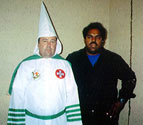 Many of the Klansmen Davis met this way were so taken aback, and then moved by his willingness to dialogue with them, that they eventually surrendered their Klan membership and presented their robes to Davis. Several became his friends. Davis has received numerous peace awards for his work, but he has also been criticized by both sides. Some Klan members who cooperated with him received threats from other Klansmen. And some reviewers condemned Davis for writing a book that puts a human face on the Klan.
A mutant from the future
I personally was so moved and astonished by his book that I invited Davis to dinner where Andy and I found him to be warm, forthright, and absolutely genuine. We liked him a lot. He is just a simple guy, no big theories or spiritual path; he gave up being a deacon at his church because he found it too dogmatic. But he had a quality of undefendedness that raised the bar on my sense of what’s possible for human beings. It was as if he were an X-Man—a mutant from the future with extra powers, or perhaps like someone from another realm. His approach wasn’t exactly to “turn the other cheek”; it was to offer to buy the guy a cup of coffee. When I asked Daryl the secret of his success he said, “You have to start by listening to your adversaries. Once you find any common ground, it becomes easier to tackle the major differences.”
Ken Wilber's integral theory tells me it's impossible to dialog across levels of development. But dialog within levels can produce amazing results. Give me 10,000 more like Daryl, strategically placed around the globe, and I’ll give you world peace in 10 years, —at least, insofar as it’s possible to attain peace in this realm.
Excerpted from my book, Wicked and Evil Isn't That Bad
Daryl Davis is a black musician based in Washington whose exuberant piano playing has been compared to that of Jerry Lee Lewis. Davis made it his life mission to understand members of the Ku Klux Klan. He set up interviews with Klan leaders around the country for his book, Klan Destine Relationships, and only upon his arrival at the interviews did his subjects learn he was black. Under extremely dangerous conditions, he worked earnestly to understand, asking questions like, “Why do you consider multiracial children to be inferior?” These questions elicited not only blatant prejudice and misinformation, but also genuine concerns by working class whites that affirmative action cut into their fair share of the pie, and that they would lose their jobs if they even expressed their concerns.
Many of the Klansmen Davis met this way were so taken aback, and then moved by his willingness to dialogue with them, that they eventually surrendered their Klan membership and presented their robes to Davis. Several became his friends. Davis has received numerous peace awards for his work, but he has also been criticized by both sides. Some Klan members who cooperated with him received threats from other Klansmen. And some reviewers condemned Davis for writing a book that puts a human face on the Klan.A mutant from the future
I personally was so moved and astonished by his book that I invited Davis to dinner where Andy and I found him to be warm, forthright, and absolutely genuine. We liked him a lot. He is just a simple guy, no big theories or spiritual path; he gave up being a deacon at his church because he found it too dogmatic. But he had a quality of undefendedness that raised the bar on my sense of what’s possible for human beings. It was as if he were an X-Man—a mutant from the future with extra powers, or perhaps like someone from another realm. His approach wasn’t exactly to “turn the other cheek”; it was to offer to buy the guy a cup of coffee. When I asked Daryl the secret of his success he said, “You have to start by listening to your adversaries. Once you find any common ground, it becomes easier to tackle the major differences.”
Ken Wilber's integral theory tells me it's impossible to dialog across levels of development. But dialog within levels can produce amazing results. Give me 10,000 more like Daryl, strategically placed around the globe, and I’ll give you world peace in 10 years, —at least, insofar as it’s possible to attain peace in this realm.
Excerpted from my book, Wicked and Evil Isn't That Bad
Sunday, October 12, 2008
A Muslim Goes to Mecca for a Jew
Stereotype busters
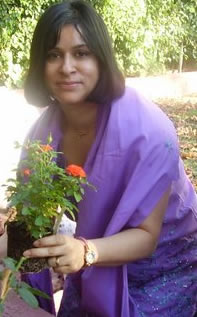 I was irritated about a client's demand that I drive way out to her house to finalize our deal. Why not just fax it? But the evening turned into a blessing: in this season of having my stereotypes busted, I added two more: Muslim values and the possibilities for reinterpreting ancient rituals.
Sharmin is a young Muslim woman who works for freedom and democracy worldwide. She wanted a website to memorialize her father, Tajuddin Ahmad. He was killed as a patriot of the Bangladesh revolution--the events that George Harrison gave the concert for in 1971.
Patties and Pilgrimage
When I arrived at her home, she had made Bangladeshi vegetable patties for me, and she insisted that we eat a bite before we work. She said the Washington Post had run a story about her cooking. And indeed, the crunchy patties were the best I'd ever had, lots of tender onion and fresh coriander. As I ate, she told me this story of her recent "hajj" or pilgrimage to Mecca. I was still impatient to get our work done, but it began to dawn on me that I was hearing something extraordinary. So I relaxed and I put my focus on trying to remember every word she said. It was something like this.
Converging at the top
Sharmin finished her story as I finished my second vegetable patty and glass of home-pressed apple juice. This is integral spirituality, I thought,— when we get beyond dogma all religions have potential to converge at the top. Sharmin then insisted that I also have some halva, a sweetened sesame butter, "So our relationship will have nothing sour in it." My spoonful was fluffy and delicately fragrant and only slightly sweet with the crunch of an occasional pistachio.
FINALLY we got to work, except I was no longer in any hurry. And indeed, the work went very well. Issues I thought would be problems melted away. I noticed how much Sharmin looks like me. We hugged goodbye, and she sent me off with fritters for my husband Andy.
Pulling away in the car, I realized this is what it's about. PAY ATTENTION TO WHAT'S IN YOUR PATH. I turned on the car radio and found tears on my face as the final chorus of a song trailed off:
And all this love is waiting for you
And all this love is waiting for you
And all this love is waiting for you...
I was irritated about a client's demand that I drive way out to her house to finalize our deal. Why not just fax it? But the evening turned into a blessing: in this season of having my stereotypes busted, I added two more: Muslim values and the possibilities for reinterpreting ancient rituals.Sharmin is a young Muslim woman who works for freedom and democracy worldwide. She wanted a website to memorialize her father, Tajuddin Ahmad. He was killed as a patriot of the Bangladesh revolution--the events that George Harrison gave the concert for in 1971.
Patties and Pilgrimage
When I arrived at her home, she had made Bangladeshi vegetable patties for me, and she insisted that we eat a bite before we work. She said the Washington Post had run a story about her cooking. And indeed, the crunchy patties were the best I'd ever had, lots of tender onion and fresh coriander. As I ate, she told me this story of her recent "hajj" or pilgrimage to Mecca. I was still impatient to get our work done, but it began to dawn on me that I was hearing something extraordinary. So I relaxed and I put my focus on trying to remember every word she said. It was something like this.
Before I left, my Jewish friend Pecki asked me to touch the feet of Abraham and ask a blessing for her. (Footprints at the central Kabba monument are said to be those of Abraham.) I told her that would be impossible because there are four million people, all trying to circle the Kaaba, and my path would be very far out from the center. And indeed, my husband and I found places in the middle of the crowd. It was a wonderful experience, all those people crowded so tightly and moving together. Everyone must circle the Kaaba counter-clockwise seven times. But no one was pushing or shoving, just looking out for each other as we all moved as one. And that made me realize we are all one.
I looked up, and I could see the stark desert mountains circling us in the distance, and then the moon and stars as they came up. I realized these were the same mountains that Abraham had seen, and Isaac and Ismael, and David. I felt connected to them. And it made me realize how important it is that we not walk around in circles aimlessly, that we must put God at the center of our walk, just as the Kaaba was at the center of our pilgrimage.
And then, it just happened suddenly as a miracle, a space in the crowd opened up, and there I was within reach of the feet of Abraham. I reached out to touch the glass dome that covers their imprint, and I said a blessing for my Jewish friend Pecki, silently acknowledging that Abraham is the father of Judaism, Christianity, and Islam. Even my husband, who normally can't wait to turn his cell phone back on, was deeply moved, and said later he wants to go on pilgrimage again soon.
But that was just one of the seven rituals we must perform. Next we must walk the path of Haagar through the mountains to the well which burst forth when her son, Ismael stomped the ground. We must drink water from the ZamZam river, the purest water of 10,000 years. And I realized, how amazing is this. First we must walk the path of God, and then we walk the path of a woman. A woman who began an entire people by her journey to the well. This speaks of the feminine power of God, and the equality of us all.
And then we had to live one night in the street as beggars. The men wear two white towels, one around their wastes, and the other over their shoulders. The women who normally wear veils must remove them, as a symbol that there must be no barriers between us. Most in my travel group were westerners. We had brought plenty of food with us, but we decided together that we should give it away to people on the streets. And by the way, most people don't realize what a modern city Mecca is. You can get anything there you can get in America, except Victoria's Secret, and get it at half price: jewels, Lancome cosmetics, Kentucky Fried Chicken. It is very safe there. I could walk the streets alone at 2 am.
Then we had to live in the desert for five days in tents. I was lucky because my travel group had only 29 women. Some groups had 200 women in a tent. You sleep right next to a stranger on a thin mat on the ground. You are supposed to pray for five days, and mostly it is a wonderful experience of sharing space with people of every color from all over the world. And most people are very kind and gentle. But not everyone. I had just finished the Landmark Forum, so I knew that I must not be judgmental of people. But one woman spent all day telling others what to do. "You are not praying right," "Your skirt is too short," she said. So I just remembered that she was running her own drama and I didn't have to get roped into it. I told her I wanted peace and quite to pray. So she stopped bothering me, but she still told everyone else what to do. Another woman started yelling at her, "How can I be holy when you are driving me crazy." She made such a commotion the men's tent sent someone over to see what was happening. But I realized, just because I was being peaceful on the outside, I was still judging her on the inside, and so I must continue to work on that."
Converging at the top
Sharmin finished her story as I finished my second vegetable patty and glass of home-pressed apple juice. This is integral spirituality, I thought,— when we get beyond dogma all religions have potential to converge at the top. Sharmin then insisted that I also have some halva, a sweetened sesame butter, "So our relationship will have nothing sour in it." My spoonful was fluffy and delicately fragrant and only slightly sweet with the crunch of an occasional pistachio.
FINALLY we got to work, except I was no longer in any hurry. And indeed, the work went very well. Issues I thought would be problems melted away. I noticed how much Sharmin looks like me. We hugged goodbye, and she sent me off with fritters for my husband Andy.
Pulling away in the car, I realized this is what it's about. PAY ATTENTION TO WHAT'S IN YOUR PATH. I turned on the car radio and found tears on my face as the final chorus of a song trailed off:
And all this love is waiting for you
And all this love is waiting for you
And all this love is waiting for you...
Sunday, September 14, 2008
A Shocking Epistemology
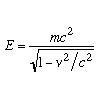


Why should you care about this post? Because it provides a grounding for conversations that dissolve into "You're irrational!" or "You're a blind materialist!"
______________
How do we know?
Have you ever been exposed to an idea that made you stomp your foot, throw the book across the room, and shout "No way!"
I've found those experiences usually mean I'm about to adopt the idea in question. I had one of those after I'd spent years in a spiritual community that celebrates intuition in line with the famous charge of Emerson,
We lie in the lap of immense intelligence which, by any other name, is Spirit... A man should learn to detect and watch that gleam of light which flashes across his mind from within more than the wisdom of all the bards and sages.The limits of intution
Yes, yes, yes! But, how do we know we are perceiving that intelligence correctly? I kept asking. Seeking an answer led me to a Muslim imam, a meditating postmodern philosopher, and a two-year stint living among Christian fundamentalists. Their answers dovetailed beautifully, and now I know how I can know—even though I may not actually know much.
Pre-rational vs. transrational
First it was philosopher Ken Wilber who put words to my feeling that just because I accepted the validity of "transrational" knowledge from the Divine, didn't mean I couldn't easily be confused with pre-rational errors.
An outside standard
Then during the two years debating my favorite fundamentalist (as chronicled in our book) I finally accepted the need for an outside standard against which "divine" guidance must be weighed--and the fact that the world's religions carry a wealth of such standards.
Resting on a three-legged stool
 And finally, it took a Muslim scholar and imam to give me the tool for integrating all appropriate outside standards with my internal guidance. I took a class from Dr. Dean Ahmad at the University of Maryland the week after 9/11. The class compressed a year's worth of college debate about religion, science, and epistomology (the study of how we know things) into an easily remembered image of a footstool. YES, as Karl over at My Integral Estimation has been arguing, we can never know anything for sure. But Dr. Ahmad taught me that the closest we can come is to rely on all three legs of the stool.
Dr Ahmad explained that Muslim philosopher Al-Ghazali took issue in 1100 AD with Aristotle's faith in reason. Reason alone is never enough, Al-Ghazali wrote. Rather knowledge rests on three legs, like a stool.
There are, however, at least two ways to count the legs. In al-Ghazali's formulation, the three legs are reason, authority, and experiment—as in the chart below.
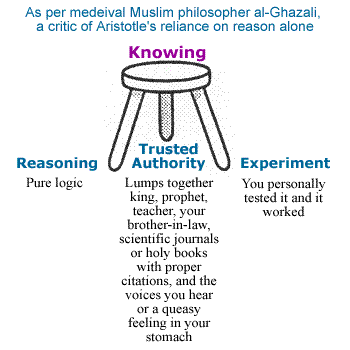
- It lumps together my least trusted source, authority, with what I've been working to develop as my most trusted, intuition.
- It attributes my feelings, instincts, intuitions, and perceived divine revelations to an authority--me! And then it asks how reliable that authority is. Drunk, crazy, gullible?
- It places God as a trusted authority--but one whose wisdom can only be gleaned via persons or books duly proven to be reliable (including myself!)
- It attributes most scientific knowledge to "trusted authority" because most of it is handed down via books and journals. I.e., Most of us don't test the speed of a falling object for ourselves, we trust that scientific literature on the topic has been developed in full compliance with the scientific method.
When the leg of mystical revelation is too long
The al-Ghazali system gave a place for personal experience, although a limited one with very little trust that any individual has a direct line to Truth. Among my self-actualized, postmodern, and mystically inclined peers, on the other hand, the opposite is true: our personal experience of feelings, instinct, intuition is the most highly trusted source. I now saw our epistemology had the same legs, but grouped differently--personal experience devalues personal experiment: Just because I tried it and it failed the last six times doesn't mean the same approach won't' succeed this time. (The fact that others tried it and failed is even less relevant.) And thus our mystical/romantic system downplays everything external to ourselves and elevates every "feeling" as equal to divine revelation, as shown below.
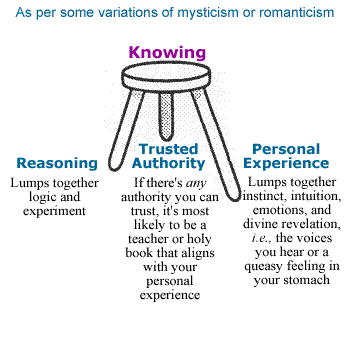
Belief in a revelation falls under my negative meaning of 'mysticism' only if it is accepted in the face of contradictory knowledge of equal or superior standing, or if the claimant to revelation (or the chain of transmission) is not known to be reliable.My own personal epistemology
For myself, I've decided to meld the two systems. My stool has a separate leg for personal experience, just like those of my romantic and mystic brethren. But that leg must now be weighed against three others.Most radically for me, respected authority now gets a full hearing, and that includes the ancient wisdom traditions of world religions.
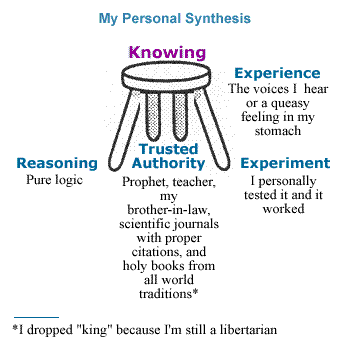
Balancing the legs
Of course, all of these "stools" present the same problem of how to balance the various legs against each other. I worked through that in our book, coming to believe it is the work of a lifetime to develop the skill to "detect and watch that gleam of light from within." So for here I'll simply note that the person who sincerely attempts to integrate all sources of knowing is more likely to find his way home in the woods—or to truth, beauty, and goodness—than the person who overvalues one leg.
P.S., I'm showing five images instead of four to honor those who prefer to see "the gleam from within" as "the heart"—or those who have trouble telling the difference, like me.
Friday, September 12, 2008
Seven Things All Religions Share
...and three things they don't
I am fascinated by Ken Wilber's list of seven commonalities of all religions.
The two other disagreements
Put clergy members from all faiths in a room for twenty years and they'll come out with a list like the one above plus two apparently irreconcilable differences.
These two differences have a lot to do with how one sees "the path." Personally, I can embrace both sides of these two questions, depending on the level of reality we're looking at. But mostly I'm with Wilber that the existence of the seven core commonalities (and many more as well) speaks to the fact that all of us are preceiving the same spiritual reality--just from different perspectives and different levels of maturity.
I am fascinated by Ken Wilber's list of seven commonalities of all religions.
- Spirit, by whatever name, exists.
- Spirit, although existing "out there," is found "in here," or revealed within to the open heart and mind.
- Most of us don't realize this Spirit within, however, because we are living in a world of sin, separation, or duality-that is, we are living in a fallen, illusory, or fragmented state.
- There is a way out of this fallen state (of sin or illusion or disharmony), there is a Path to our liberation.
- If we follow this Path to its conclusion, the result is a Rebirth or Enlightenment, a direct experience of Spirit within and without, a Supreme Liberation, which
- marks the end of sin and suffering, and
- manifests in social action of mercy and compassion on behalf of all sentient beings.
The two other disagreements
Put clergy members from all faiths in a room for twenty years and they'll come out with a list like the one above plus two apparently irreconcilable differences.
- Is Spirit personal or impersonal?
- Is man inherently good or bad?
These two differences have a lot to do with how one sees "the path." Personally, I can embrace both sides of these two questions, depending on the level of reality we're looking at. But mostly I'm with Wilber that the existence of the seven core commonalities (and many more as well) speaks to the fact that all of us are preceiving the same spiritual reality--just from different perspectives and different levels of maturity.
Monday, September 1, 2008
How to Comment or Subscribe to Blogs
How to comment
Click "Comment" below one of my blog posts.
During periods when I'm not getting too much spam, you can identify yourself by simply choosing name/url below the comment box. I strongly encourage use of real names and discourage "anonymous" comments which may be deleted.
When I have a higher level of security turned on, you'll need a Google account or an OpenID. OpenID is a great system that assigns you a web address that you can use like a password at many sites on the web. It can be as simple as this: http://myname.com
An OpenID is free, and you can get one from many different providers. Usually the provider's name is part of your OpenID. For example, if you get your OpenID from Wordpress it will look like this: http://(user name).wordpress.com
If you don't already have an OpenID, learn more or get one here. I recommend it.
Once you have a Google account or OpenID, choose the correct option below the comment box on one of my blog posts. For OpenID, you can type in your whole address yourself or choose the little icon from one of the top providers to automatically fill in one of these partial addresses:
I love getting comments, so go for it!
Click "Comment" below one of my blog posts.
During periods when I'm not getting too much spam, you can identify yourself by simply choosing name/url below the comment box. I strongly encourage use of real names and discourage "anonymous" comments which may be deleted.
When I have a higher level of security turned on, you'll need a Google account or an OpenID. OpenID is a great system that assigns you a web address that you can use like a password at many sites on the web. It can be as simple as this: http://myname.com
An OpenID is free, and you can get one from many different providers. Usually the provider's name is part of your OpenID. For example, if you get your OpenID from Wordpress it will look like this: http://(user name).wordpress.com
If you don't already have an OpenID, learn more or get one here. I recommend it.
Once you have a Google account or OpenID, choose the correct option below the comment box on one of my blog posts. For OpenID, you can type in your whole address yourself or choose the little icon from one of the top providers to automatically fill in one of these partial addresses:
- Live Journal
- Word Press
- Type Pad
- AIM
I love getting comments, so go for it!
Subscribe to:
Posts (Atom)


 Posts
Posts