"Transcend and include... this is the self-transcending drive of the Kosmos—to go beyond what went before and yet include what went before... to open into the very heart of Spirit-in-action." Ken Wilber, A Brief History of Everything

"Wouldn't it be wonderful if a group of people somewhere were for something and against nothing?" Ernest Holmes

Sunday, October 23, 2011

Integral Occupy Wall Street: Love and Shadow

Integral commentator Joe Perez notes that an Integral presence at Occupy Wall Street will not be based in resentment but in love and full acknowledgment of our own shadows.
Integral politics knows you can't just burn down the banks....Integral morality does not arise from resentment, feelings of jealousy, or animosity of any kind. It asks us to look at our individual shadows and acknowledge when our own antagonism towards the ultra-rich borders on its own sort of greed and will to power. Integral politics is based on love.
Beautiful Joe!

Because my Integral Life Practices Meetup group in DC was just working with the book's shadow module last week, I wondered how such a shadow-aware protest might look. Just for fun, I've revamped an old sign:


Monday, July 18, 2011

Integral & EnlightenNext: The Marriage of Map & Path?

A day of exploring "the Union of Theory and Practice" with leaders from Integral and EnlightenNext generated a surprising level of enthusiasm for cooperation between the two movements. This surprised me because I thought the day was to be about unifying theory and practice in our own lives. And thus, I expected a discussion of  transformational practice groups.  But the two levels of focus came together beautifully for me at the end when I was able to propose a practice group exchange as one of the ways the organizations could explore closer cooperation.


Second Generation Facilitators
Jeff Carreira left, Clint Fuhs, right
 
Our facilitators for the session July 15/16  were top students of the leaders of the two movements: Clint Fuhs from Ken Wilber's Integral and Jeff Carreira from Andrew Cohen's EnlightenNext (formerly What is Enlightenment). And thus, they referred to themselves--and us--as the "second generation" in these movements.  (They actually used the term "lineages" instead of movements, and I can say that with a straight face if it is understood as Integral being in the lineage of Neo-Platonism and EnlightenNext in the lineage of some aspects of Eastern philosophy--with, of course, Andrew Cohen's radical twist that evolution is unending, rather than cyclical as Wilber and many of the Eastern traditions maintain.)

Jeff is the Director of Education for EnlightenNext, and Clint is the Director of Core Integral which offers college level courses on Integral theory. Both men love ideas, and I could have sat all day for their rapid fire exchange. And yet, both men also exude that quality of presence that makes me feel they walk their talk.  Clint made us laugh playing gunslinger, whipping concepts out of both holsters. "Integral is not a path, it's a map," he said. I laughed especially loud when one fan of Rumi asked, "How do you relate to the heart?" and Clint said, "We map it."

Which Comes First?
Clint told us that practice precedes theory: while most people think Ken Wilber took up meditation, for example, because of his theory, it was actually his experiences of practice that led to Integral Theory, he said. My favorite point from Jeff may have expressed the opposite truth. He said he stopped being a seeker when he realized that enlightenment as a state experience might never happen to him; he couldn't wait for it. "Forget enlightenment. I want freedom now!" he had proclaimed.


The facilitators set us to work early. In small groups we completed the sentence stems:
  • What I bring to this discussion is....
  • The gifts of Integral/EnlightenNext are...
  • The shadows of Integral/EnlightenNext are..
  • How the two lineages could support each other is...
Authenticity: What's their Secret?
In my small group, I was impressed with the ease with which the ENext folks spoke from an authentic, intentional place, apparently setting ego aside. I have actually noticed this quality in many of the ENext people I have met, going back to the day I met Steve Haase when he and I were the only two to show up at the first meeting of the DC Wilber Meetup. How did these folks maintain that quality over time? What practices are they following? I determined to find out.

Gifts and Shadows
The results from our groups looked something like this--with my editorial additions and rearrangements:


This exercise covered a lot of ground quickly and diffused tensions in the room. A rich camaraderie began to develop between the two groups. Jeff pronounced that the results were "no surprise," and challenged us to consider, therefore, that the problems we listed were not really shadow because they were obvious to everyone. The shadow, he said, is the fear or grasping that prevents us from addressing the problems we all acknowledge. I was still pondering that when my Integral buddy Anita voiced my next thought, "This looks like a polarity map: not problems to be solved, but polarities to manage."   ENext folks started saying, "I'd like to learn more about Integral Theory--and lining up to buy Clint's course.

Followup 
Our final practice of the day was a circled up conversation of "Whatever wants to be spoken into the room," facilitated by Jeff.  Several of the ENext people expressed an intense desire for closer cooperation between the two groups. Clint warned that that kind of enthusiasm can be difficult to maintain; was anyone willing to make specific commitments for followup?

The idea for the day was birthed by local coordinators for the two groups: Malcolm Pettus from the DC Ken Wilber Meetup and Ryan Diener from the DC EnlightenNext.  Malcolm committed to make Ryan an assistant coordinator on the Meetup site, which would give Ryan direct access to posting events. Several of the ENext folks offered to establish joint mailing lists. Clint and Jeff said they would be open to returning in six months for a follow up session.

Practice Group Exchange
I offered to coordinate a practice exchange. I explained that members of the Wilber Meetup have been experimenting with various formats for practice groups; it could be useful and enlightening to learn what ENext does before we shape our next round. I am thinking something like a few of us visit one of their sessions and then invite them to attend one of ours--something like that.

Most folks went to dinner together afterwards, and the ENext folks invited us to a picnic the next day. All in all, a fine start to a courtship.
Event organizers: Malcom Pettus first row, second from left (between Clint and me) and Ryan Diener third row far right.
Chief chauffeur and love muffin Anita maintains her usual low profile third row far left.

Comments heartily encouraged.

Monday, January 10, 2011

Pantheism vs Panentheism as God's 3rd Face

I am God
You are God
It all is God
As I explore what it means to integrate all three faces of God, the distinction between pantheism and panentheism fit what I was experiencing. In pantheism, the material universe IS God. And hence I can worship nature or, in a more "sophisticated" version, tremble in awe at the laws of physics. And I have done both. They are both flavors of the third face of God as expressed by Ken Wilber and Terry Patten.

I had long since left behind the second face of God from my Catholic childhood; "You, a force outside me, are God."

Then in New Thought metaphysics I began to have experiences in which my intention appeared to shift the outcome of a situation. And hence I experienced a version of the first face of  God, "I am God," which evolved into, "I am a co-creator with God" or "I am God expressing."  

But as I continued inquiring into WHAT I was expressing or co-creating with, I cycled back around to the inescapable conclusion that it was indeed a force outside of me, and something more than the laws of physics. This is Panentheism. Material reality is IN God, but is not all of God. In my current understanding, Panentheism integrates all three faces of God. Ken Wilber and Andrew Cohen, leading proponents of this integration, have declared themselves to be "Evolutionary Panentheists." A beautiful expression of panentheism is found in this song below, "God is More Than This," sung by the Agape choir in Los Angeles and interrupted by a brief sermonette by Rev. Michael Beckwith.


My understanding of this continues to evolve. But my experience of it deeply enriches my life.

Sunday, January 9, 2011

Three Faces of God: Why Care

I am God
You are God
It all is God

There are many ways to understand what Ken Wilber calls "the Three Faces of God." Most of us learn them in the reverse of the order stated above:
  • Third person:: It: rivers, moon, and sky are God
  • Second person: You the Father from the stories of my ancestors are God 
  • First Person: I in my oneness with all that is am God 

And as we grow we usually reject our earlier understandings. But is there room for all three? Does there need to be?

I was lucky to make the break to First Person easily in my thirties, twenty+ years ago, when I discovered New Thought panentheism. But the adventures recounted in my book drew me around to reconsider what I'd left behind, bringing my new consciousness of radical freedom and responsibility to the old stories. For me there are three reasons to do so:
  • The sheer joy of a devotional relationship
  • The improved relationships with my teammates that are possible when we put something sacred in the center of our circle
  • An ability to embrace followers of traditional religion as brothers and sisters

In reintegrating this second face, you don't have to go as far as I have--twirling a white skirt to praise dance at a Black church. Simply chanting, or lighting a candle, or even writing a love poem to your hero may be enough for you to call forth the presence of beloved Other. Whatever it is, I recommend it. It can be a powerful source of meaning and joy.

Wednesday, December 8, 2010

Darmok and Jalad at Tanagra: How I lived out this Star Trek episode

Recently I saw again one of the most famous episodes of Star Trek Next Generation, "Darmok and Jalad at Tanagra." I sat riveted, seeing with new eyes how this story reflects my adventure with Bishop Thomas and the biblical literalists at Highview.

In the show, Captain Picard confronts an alien race that communicates only via metaphor from its ancient myths--just as my new friends at Highview attempt to solve all problems with stories from the Bible. Struggling to communicate, the alien captain beams himself and Picard to a planet where a beast is loose, and he repeatedly says to Picard, "Darmok and Jalad at Tanagra!" Picard is confused and shivering in the cold until the alien captain offers him fire saying, "Temba, his arms wide!"

Suddenly Picard understands how metaphor is being used. "Temba, his arms wide" is a metaphor for giving and receiving. Then Picard recalls Gilgamesh, one of earth's most ancient legends, a story of how two enemies became friends through hardship. He realizes that "Darmok and Jalad at Tanagra" must be a similar story, and that the alien captain has risked his own life to open communication between
their peoples by fighting the beast together with Picard. Alas, the alien, Dathon, is mortally wounded by the beast. As Dathon dies, Picard shares with him the story of "Gilgamesh and Enkidu at Uruk." Dathon dies knowing he has succeeded in opening communication with Picard. Picard returns to his ship with enough knowledge to halt the war that is brewing with Dathon's people.


And that is the story in my book, "The Bishop and the Seeker: Wrestling for the Soul of the 21st Century." As a postmodern Integralist and follower of New Thought, I am beamed into the office of a fundamentalist bishop for a year of dialogue where we discover our common enemy: the excesses of postmodernism and alternative religion in which there is no right and wrong. We tell each other stories and learn each others' language. The bishop's equivalent of "Temba, his arms wide" is to offer me the openness to be genuinely interested in learning about my world. In fact, he risks his reputation among some of his own hardliners by telling me he believes I am saved, even though I do not call myself Christian.


I return to my ship to bring the message. We can work with these people, they can be friends. Instead of focusing on our differences, look at the good work we can do by focusing on our common aims to bring truth, beauty, and goodness to the world.

Friday, October 29, 2010

Bringing A Wilber Meetup Back from the Brink

Gail Taylor
How many Integral Coaches does it take to save a Meetup group about integrating all perspectives? Last night Integral Coach Gail Taylor facilitated a meeting I would have said had very little chance of success. Tensions had been mounting for years in the DC Ken Wilber Meetup, a group with a vision so broad that aspects of it are at odds with itself. In a group about "transcending and including" all values, a split had evolved roughly along lines of age, with the younger members more focused on transcending and the older on including. (This is an over simplification, because we're experiencing tension on the other AQAL poles of stability/change, interior/exterior, and autonomy/interdependence with everyone committed to all those values but showing preferences roughly matching age groups.) Most similar groups around the world have dissolved over the kind of tensions our group was suffering. Dissolution was imminent.

But within two hours, Gail's facilitation brought us back from the brink. Not to say our problems were solved, but I would say we established a minimum level of trust for moving forward for three more months at which time we'll reassess.

Holocracy to the Rescue

How did she do it? Much of her approach stemmed from her training in Brian Robertson's Holocracy.  She started by asking us what level of facilitation we wanted from her, and most of us said, "medium." She put on the wall a series of prepared "cheat sheets" for how we'd proceed, including speaking from our "core values" and taking a breath before responding to each other. As we surfaced our issues, she did two things extraordinarily well: she put on paper a one-sentence summary of  everyone's input on a given topic, and she acknowledged tensions as people spoke, coaching individuals to rephrase something as a request or to notice a contraction in what they'd requested. She did this with an open-hearted humility that felt contagious. I felt heard and looked out for--and this was particularly noteworthy because prior to the meeting Gail had been working with the "transcenders" and thus could have found it difficult to present herself as neutral.

How Many Integral Coaches?

Another factor in the evening's success was how well prepared we all seemed to be. Everyone worked hard to communicate constructively and be transparent. In the days preceding the meeting, several of us got coaching from some of the other top Integral and Holocracy coaches nationwide. In a flurry of two-hour phone calls, several of us spoke with each other interspersed with calls to Gail and Beena Sharma; Ron spoke briefly with Brian Robertson, and Ron invited us to track the process Deborah Boyar will be using in working with California's Bay Area Integral.

And the Result is..

Here is the initial vision statement Gail wove together for us in 14 minutes of our three hour meeting:
“We are a community of practice (and more) in service to the broader integral community, offering great events around Ken Wilber’s (and related) work. We value fostering learning, balance, and the integration of perspectives and visions (including allowing for different perspectives and visions).”

Tuesday, June 15, 2010

Integral Transformational Practice Groups: Support for Embodying Enlightenment


I'm excited about an integral, small group process developed by James Jones for embodying enlightenment or "Christ consciousness:" Transformational Practice Groups. These are similar to groups for Integral Life Practice, but organized around the six domains of spiritual practices identified by Roger Walsh in Essential Spirituality and sequenced in a way informed by Ken Wilber's Integral Theory.

I've been in a group for two cycles of six weeks and am fascinated by its potential. I'll write more about this later, but that's my group shown above. We are supporting each other in doing practices every day that remind us to embody all the lofty goals we talk about as the fruits of Enlightenment or Christ Consciousness.

Tuesday, March 2, 2010

Plato, Climate Change, and the Cathedral at Chartres

In a last minute stroke of genius, Ron persuaded Jim Turner of the Transpartisan Center to give opening remarks prior to last night's compelling manifesto on Plato, climate change, and the Cathedral at Chartres by Jim Garrison.
[note: this is my personal report of the March 1 meeting of the Ken Wilber Meetup of Washington DC.]

About 40 of us crowded congenially into the somewhat awkwardly long and narrow second floor of the old townhouse that is Bistro Tabac on U Street. (Those of us who stayed for dinner afterward ascended the castle stairs to gasp in delight at the romantic, glass-walled, rooftop with soft candlelight setting off a glittering view of the monuments.) Along with a dozen or more guests in town for Wisdom University (where meditation and art classes are required alongside academic analysis) we also had several newcomers to our Meetup who we are eager to see again.

Both speakers started by acknowledging their debts and close relationships with Ken Wilber: Jim T consulted with him recently and found him in good health; Jim G said history will compare him to Plato, after whom all philosophy since has been only footnotes.

Jim Turner's remarks practically had me leaping to my feet from my little red mushroom stool as he described politics as lurching from walking solely on one's left foot, becoming exhausted, and then walking solely on the right foot until exhausted again. He called for a recognition that each of us has politics as individual as our fingerprints, but under-girding our views are the same competing poles: particularly of freedom vs order. And we're not going to get anywhere until we can address the concerns of both poles in a way that frees them to recognize their own need for the opposite pole. This is very much a theme of my own work in dialoguing with fundamentalists and thus resonated strongly. Where do I sign up?!!

Jim Garrison, board member of Wisdom University and founder of the State of the World Forum, called us to wake up to the fact that 90% of humanity will be wiped out within 40 years if we don't act immediately to cut carbon emissions by 80%. When a questioner challenged the doability of that, Jim compared hesitation to hanging one's head in despair as a fire is breaking out in the kitchen. STOP EVERYTHING and fight it, he said. He also told us that corporations can reach the targets with cuts in their profits of only one third, and that he is finding foreign corporations more receptive than American, with Brazilian firms replanting the rain forest and Chinese firms leaping out front in developing green technology. He also did the anti-corporate greed thing, warning us that all information contrary to this dire view is paid for by corporate interests just as was the campaign that cigarette smoking is safe. He called for counterweighing the American tendency to colonial avarice with a re-integration of the divine feminine principles portrayed in the movie Avatar and in the "Taj Mahal of France," the Cathedral at Chartres with its origins in a vanished mystery school and its stained windows portraying the zodiac and universal oneness. (My family's native village of Belleme is an hour south of Chartres. Road trip anyone?)

At the end I felt an overwhelming desire to integrate the passions of our two speakers. As Ron asked at dinner afterward, how can Jim G's message be communicated with Jim T's insight about what is needed to reach people with a very different worldview? I was also confused by the followup remarks of Jim Garrison's colleague that sustainability will create prosperity. While that is clearly true in the long run, how does it square with Garrison's call for a one third cut in corporate profits? Doesn't that mean a one third cut in my retirement fund, setting my thermostat to 40 degrees, and walking the ten miles to work? I am willing to do that if that will save the earth. But I suspect (and here I am editorializing) that much of the resistance to believing in climate change is really fear that the cure is almost as bad as disease. How do we speak to that?

Big thanks to Ron for putting together this provocative and inspiring evening and to the Meetup core group whose teamwork made everything work smoothly.

Thursday, February 11, 2010

"Boomeritis" vs. "36 Arguments for the Existence of God"


I was only a chapter in to the smash new novel "36 Argurments for the Existence of God," when I realized how much it has in common with Ken Wilber's "Boomeritis"--and with my own true story.

I had dashed out before a looming blizzard to get "36 Arguments" as my snowed-in companion. From the dust jacket, it might be mistaken for a Dan Brown thriller:
"After Cass Seltzer's book becomes a surprise best seller, he's dubbed, "the atheist with a soul" and becomes a celebrity. He wins over the stunning Lucinda Mandelbaum, "the goddess of game theory," and loses himself in a spiritually expansive infatuation. A former girlfriend appears: an anthropologist who invites him to join in her quest for immortality through biochemistry. And he is haunted by reminders of the two people who ignited his passion to understand religion: his mentor and professor--a renowned literary scholar with a suspicious obsession with messianism--and an angelic six-year-old mathematical genius who is heir to the leadership of a Hasidic sect. Each encounter reinforces Cass's theory that the religious impulse spills over into life at large...."

As in "Boomeritis," some of the action in "36" takes place as our hero is listening to a lecture on "The Myth of Moral Reason" while flirting with a comely anthropologist and flashing back on transcendental experiences he had as a child. In both novels, these experiences are really, really well described, such that they may recreate such experiences for many readers. I sure floated out there.

But the first paragraphs of "36" told me that author Rebecca Newberger Goldstein is also fascinated by the same trend of retro religion that Wilber mines and that has ignited my life. She writes
"Something shifted, something so immense you could call it the world.

Call it the world.

The world shifted, catching lots of smart people off guard, churning up issues you had thought had settled forever beneath the earth's crust. The more sophisticated you are, the more annotated your mental life, the more taken aback you're likely to feel, seeing what the world's lurch has brought to light, thrusting up beliefs and desires you had assumed belonged to an earlier stage of human development.

What is this stuff, you ask one another, and how can it still be kicking around, given how much we already know? It looks like the kind of relics that archeologists dig up and dust off, speculating about the beliefs that once had animated them, to the best that they can be reconstructed, gone as they are now, those thrashings of proto-rationality and mythico-magical hypothesizing and nearly forgotten.

Now it's all gone unforgotten, and minds that have better things to think about have to divert precious neuronal resources to figuring out how to knock some sense back into the species. It's a tiresome proposition, having to take up the work of the Enlightenment all over again, but it's happened on your watch."
Ken Wilber's Integral Theory also concerns itself with how religion expresses through the levels of human development and is currently re-emerging in its magic/mythic forms. And from just the first chapter of "36 Arguments," I smell that Newberger Goldstein is pursuing a variation of Wilber's rallying cry: that postmodernism has thrown out the baby of Truth-Beauty-Goodness with the bathwater of mythic religion and thus set itself up for a rebound bigtime.

And that rebound is what I am still living through as told in my book, "The Bishop and the Seeker: Wrestling for the Soul of the 21st Century." Dan Brown's novels feed the desire to replace traditional religion with something more like the metaphysical New Thought movement I followed for 20 years. Whereas my experience of stumbling into an amazing fundamentalist church taught me to re-value and include the good parts of traditional religion while transcending the rest.

As I continue reading "36 Arguments" I expect to have a lot to say on the comparison between my experience and the novels of Wilber, Goldstein, and Dan Brown.

Sunday, August 9, 2009

My First Intergal Coaching Session

Leslie Williams of Integral Coaching Canada recently agreed to help me through some blocks I was encountering in getting my book published. The book is the fruit of my own spiritual journey and my interest in Ken Wilber's integral theory; it recounts my amazing two-year adventure dialoging with a fundamentalist pastor and getting to know second person God.

Leslie agreed to meet me between corporate appointments at an Embassy Suites hotel in Herndon, Virginia. We sat in a magnificent atrium aside a waterfall and pond with two full-grown, live swans floating peacefully. Leslie listened intently as I let two years of frustration about publishing roadblocks come tumbling out. Then she told me she was hearing primarily issues from the left-hand quadrants: "I'm frustrated that" or "I'm afraid that" rather than "I can't" or "I don't have the resources to." She suggested the metaphor of a river plunging downstream and encountering boulders. "Let's find out which of these bolders is the main one," she suggested, "so I can get a sense of whether you need a therapist, a spiritual director, a motivational coach, or just somebody to help you get organized. Which of these issues has the most heat?"

Leslie actually arranged for a flip chart to be brought to us. As I continued to explore, it became pretty apparent where the heat is, and some of it regards the existential questions explored in the book itself. Was this project, "meant to be," and if so what does that mean?

An all-quadrant approach
Checking frequently to see if she was on track, Leslie suggested some approaches to each of my issues. And even though the blocks are left-hand (interior), her approaches included right-hand actions: pinning down some people whose offers to help me have been vague and even taking a class in aikido to prepare myself to stay balanced when people attack some of my controversial observations--like the fact that new agers and fundamentalists are actually very close in their experience of how reality works, but their levels of perception cause them to use opposite languaging. Leslie recounted that her own experience in interracial work is that the peacemaker is often shot at from both sides.

Leslie also had me draw three concentric circles representing the levels of control I have over each of the issues that is bothering me. She noted that most of my issues are in the outer circle--things I have no control over whatsoever, like whether the book will get the kind of key break that would bring it to the attention of the wide audience I seek to reach. She suggested that given the potential I sense for the book to do good, I need to just keep on moving forward no matter what comes, to "Let go and let God."

There was more, a few things I won't share. But the end result was that I felt completely heard and "vibed with." In fact, I smiled later realizing how her JOB as an integral coach is to communicate on my level while seeing things from a broader perspective. Would she have said some of the same things to someone whose book had an opposite premise?

As she left me with the swans, I felt clearer, lighter, inspired, and challenged. I laughed at myself to hear in my head the theme song to "Man of La Mancha": "And I know, if I'll only be true to this glorious quest..."

I went home and collected clip art to make a collage of how I was feeling. It was extremely satisfying to place each frustration on the periphery with an image in the center of me putting together the puzzle pieces of a multifaceted gem.


And then I remembered the last time that two swans had captured my attention. It was last summer when I visited the village of my ancestors in France, Belleme. Two swans have always lived in the moat that surrounds remains of the castle at the top of the hill. And when I saw them last summer 30 years from my prior visit, I felt familiarity with a timeless peace. Then as now, they were a gentle presence, and a beautiful reminder. So I looked at the photo I took of that moat, and noticed the free-flowing fountain at the center of it. In fact, the fountain is spouting right out of that "boulder" in the center.


Leslie's approach was exactly what I needed, and in the week that followed, several good things fell into place. I signed on with Intermedia publishers, I got a great review from a fellow integralist, and a journalist friend offered to help make contacts for my marketing plan. I am grateful to Leslie, and to the swans.

Friday, August 7, 2009

Web Design Classes at Arlington NOVA

I'll begin teaching Web Design classes at the the Arlington campus of Northern Virginia Community College in September. The following classes lead to a Web Design certificate at Arlington NOVA:
  • Dreamweaver
  • Web Graphics
  • Content Management Systems
Arlington is a satellite location of the Alexandria campus of Northern Virginia Community College, (NOVA) located in the Ballston area of Arlington.

Wednesday, July 22, 2009

How to Handle Hate Mail

A nice example this morning from the ex-owner of Nathans at her new blog, CarolJoynt.com. She's a Web design client of mine, and just yesterday I finished her new blog and she issued her first post since her popular Georgetown pub closed last week due to the economy and back taxes. You may have heard all the buzz about the "Citizens Bailout" of people donating money to help Carol save her house.

Well within 24 hours she had a hate mail rant. She's the kind of person who posts several times a day, but her old blog--which I also did, was manually operated with no comments. So this was the first time she had to decide how to handle a comment.

By an odd coincidence, Tom Curran of the DC Meetup for my favorite philosopher Ken Wilber posted this quote for the day from David Hawkins' "Power vs. force,"
"Ignorance does not yield to attack, but it dissipates in the light, and nothing dissolves dishonesty faster than the simple act of revealing the truth. The only way to enhance one's power in the world is by increasing one's integrity, understanding and capacity for compassion."
I immediately sent the quote to Carol, but it turned out she needed no advice. She had already written a very classy reply, a textbook example of how to deal with hate mail. She offers no resistance, and no counter-attack, not the slightest sense of snideness. My hat is off to her for that because I personally need 24 hours of deep breathing before I can pull off a response that pure. The only thing that would possibly have improved the sense of integrity it conveys would be to find some guilt to admit to, like maybe, "Well, yes, in 2002 I did drink one glass of champagne that I didn't pay for."

PS: Blogger vs. TypePad
By the way, I originally planned to set Carol up with one of these Blogger blogs, but she preferred Typepad which she considers classier. Its main advantage that I see is that it permits you to post non-blog pages, and thus acts more like a full website. If anyone wants a consult on that, I'll be happy to oblige.

Saturday, June 20, 2009

Why I love "The Goode Family"


At first glance, this new animated show The Goode Family is an over-the-top caricature of green cultural values, which unfortunately earned it some scathing reviews.  But look closer and see a subtle examination of goodness that transcends both traditional values and postmodern political correctness.

The show is the latest offering from Mike Judge, creator of  "Beavis and Buthead" and my beloved "King of the Hill."  Gerald and Helen Goode strive to be good by recycling, befriending minorities,  and feeding their dog a vegan diet. Moderate daughter Bliss rebels by exploring evangelism while their not-too-bright adopted son Ubuntu just wants to be liked and play Bingo. The family gets caught in contradictions at every turn and must decide where the good really lies.

A great review of the Goode Family at Enlighten Next captures my favorite moment in the first episode. Helen is creeped out that her daughter shows interest in a chastity event at an evangelical church. Her husband Gerald’s response
presents her with one of the hilarious contradictions faced on the path to perfect political correctness: “Maybe we shouldn’t be so judgmental,” he says. “Don’t we always try to celebrate people’s differences and learn from them?” To which Helen responds, “Sure, if they’re like Native Americans or backwards rainforest tribes. But not these people!”
This attempt to be nonjugmental brings much of the show's conflict.  In one episode, Ubuntu wants to play football. Despite the parent's dismay, Gerald goes along with Ubuntu for a pep rally and tries to get in the spirit. But a line is crossed when the other fathers want to slay a pig representing the opposing team. The moral fog lifts and Gerald leaps to stop the slaughter, even though it means fighting off a much bigger guy in full bloodlust.
A similar theme of moral clarity arises in another eposode in which the Goodes accidently offend a chic lesbian couple who hold the key to Helen's coveted place in the Art League. To make amends, they seek to prove they are not homophobic by seeking out another lesbian couple to befriend. To their initial dismay, the couple they find are barrel-chested, beer guzzling, truck drivers. But these lesbians have a sweet affection for each other and a genuineness that is lacking at the snarkey parties of the Art League who ridicule the low class couple. When forced to choose, Helen sides with the truck drivers--for a night of bingo.

Neil Pedley captures this balanced counterpointing in a UReview of the Goode Family:
Careful to showcase first and foremost the humanity of such reactionary figures as Hank Hill he not only enables those who are different to laugh at his antics, but those who are most similar to comfortably laugh along too. This lack of disdain on his part is his secret weapon and the reason he was able to transform the likes of Beavis and Butthead into an icon for the MTV generation despite them being a mocking, unflattering, distorted manifestation of the very people who were watching.
For its rich exploration of moral dilemmas, The Goode Family warms my heart and tickles my mind. 

Monday, June 15, 2009

"Three Faces of God" & Integral Practice

Re-integrating the Beloved Other

Do you find it easier to do devotional chants in Hindu than in English?

That's one of the questions posed yesterday at the high energy workshop on Ken Wilber's "Three Faces of God" held at the Celebration Center of Spiritual Living in Falls Church, VA
.
Speaking mostly to members of the New Thought community, Rev. Sophia Ducey told 22 of us that Science of Mind does a world class job of knowing God as the "I Am" presence but can be conflicted about the comforting presence of the "Beloved Other." Through meditation, chanting, and dialog, she invited us to look again at how our image of God had changed over our life: was it an enlargement or a pendulum swing AWAY from something we rejected which might then call us back to center? If we were still reacting against something, she recommended shadow work to fully include any babies thrown out with bathwater. She got down on her knees to demonstrate her own quest to re-integrate surrender and devotion to the Beloved Other, which then, she said, reinforced her sense of the God inside.

Integral Practice
Rev. Sophia also said that the work of Ken Wilber alerted her to the
need for practice to develop each aspect of our selves. Again, Science
of Mind is a leader in promoting the interior practices of prayer and
meditation, but puts less emphasis on body awareness, right action in
each moment, and right relationship with fellow members of our spiritual
community. She and her partners in Canada are developing Integral
Practice Groups--a container for small groups to support each other in
this full array of practices.
How this came together
When Rev. Sophia left the Religious Science church she was
ministering to in Vancouver to focus on this work, she asked a Christian
church to rent her space. It turned out that pastor, Bruce Sanguin of Canadian Memorial, had authored a book on integral congregations, so they are now working as a team along with a Buddhist and an Anglican. Now THAT'S integral! Of course, one of the pioneers in how to run an integral practice group is our own James Jones of Personal Awareness Institute and our DC Ken Wilber Meetup.
We asked Rev. Sophia for more. She is in transition and doesn't know when she'll be back in DC, so I may explore with Rev. Trish, senior minister of the Celebration Center, whether there are other ways we can keep the conversation going in the meantime. Also, Sophia tells me that her group in Vancouver has an upcoming visit scheduled with Integral Coaching Canada. So lots of good things happening in Canada these days. We may have to get used to being referred to as "south of the border."

Sunday, April 26, 2009

I recommend "Church Junkie"

Great piece in the magazine section of today's Washington Post by a secularist woman who went back to church when she was "in dire need of people who would be nice to me for less than $125 an hour." After trying several churches she ended up in the welcoming embrace of "a bald, black, Episcopal minister with overstated earrings and a rock-steady voice."

Sounds something like the adventure that led to my book. The latest on that is that my agent and cover coach are both urging me to change my title: under consideration are "Fundamental Differences" and "My Fundamental Enlightenment." Any votes? HarperOne and Inter Varsity Press are both considering it.

Tuesday, February 17, 2009

The Humor Line: How to Stop a Bully

I've been musing that a person's sense of humor can serve as a marker for their other lines of development: mental, emotional, spiritual, ethical, etc. I'll get back to that in another post. But while researching levels of humor, I stumbled upon "Bullies to Buddies" an amazing site offering a book about how to stop childhood bullying.

To anyone with children I highly recommend chapter 5 on protecting the victim with "four magic words."

I also recommend to everyone Chapter 9 about humor as violence vs. humor as courage. Author Izzy Kalman MS argues that the Columbine high school massacre can be seen as a failure of the sense of humor of the children being bullied!

[Photo permission pending. Do click the image for a very funny gallery of painted images.]

Saturday, February 14, 2009

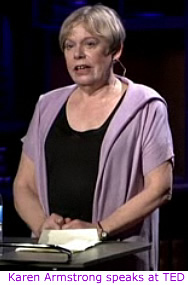
Meeting Karen Armstrong at Sacred Circles

I'll confess that the main reason I went to the Sacred Circles conference at Washington's National Cathedral last night was to meet ground-breaking religious Historian Karen Armstrong (History of God, Battle for God, Spiral Staircase). But the evening would have been memorable even if the universe hadn't conspired to make my dream come true.

The annual woman's interfaith event drew perhaps 600 women for the theme "Love in Action," and Armstrong was the keynote speaker calling for all world religions to recognize compassion as their common root.

A really real cathedral
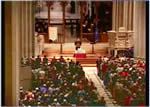
The soaring cathedral took my breath away. I had forgotten that this is a really real Cathedral which was perhaps shown off to its best by the contrast of classic stone pillars as backdrop for childrens' art and colorful displays from world religions. A portrait of First Lady and President Obama's inauguration day visit graced the entryway.


But it was the pageantry of the evening itself that most struck me. And I have to say that my appreciation was heightened ten-fold by a conversation I had a few hours earlier with my fellow Ken Wilber fan James Jones of the Personal Awareness Institute. James knows everybody and everything in personal and spiritual growth. He had just been telling me over coffee that all religious rituals can be identified with one or more of the levels of consciousness described in Spiral Dynamics (similar to the chakra system).
  • from the archaic level, use of the body
  • from the magic level, recognition of good and bad forces
  • from the power level, sacrifice for protection from enemies
  • from the mythic level, joining with God in an agreement to work together
  • from the higher levels, calling forth God from within ourselves
So I smiled broadly as we started by having Cynthia Winton-Henry of InterPlay lead us to stand and "shake your arms and legs and the thing that you sit on." Then a Lakota medicine woman in a fringed garment and buckskin boots called us to face the four directions as she burnt sage, shook rattles, and made an offering of tobacco to the spirits of mind, body, spirit and earth. (I had to let go of concern that Muslims or orthodox Christians in the room might be uncomfortable about participating.) We chanted to create a holy space, and the tones shimmered as they echoed in the vast archways overhead. Colorful streamers wafted in the high spaces as angelically dressed bearers waved medicine flags from 20 foot poles.

Next came Anglican scholar Esther de Waal wearing black and gold with a necklace that appeared to be a large iron cross. In a formidable Teutonic voice she called forth the Celtic gods. (I am mis-remembering some of the theologic details, but you get the idea.) And finally came a beautiful bald woman in dangling, red earings and cream-colored robes that appeared Buddhist but for the starburst on the back. This was Rabbi Phyllis Berman who told us she lost her hair as a young person because of an allergy. After 20 years of hiding under a wig, she learned that facing the world as she is brought her the gift of being able to see others as they are, as well. With a radiant smile she led us in a Hebrew chant she translated as "Expand the boundaries of my tent."

Walking up the chakras
I felt exactly as if I had just walked up the chakras --except, of course, for intellect, the hole filled by Karen Armstrong. She told us of her project with TED to create a worldwide charter for compassion. And she told us of her journey: from failed nun, to producer of British TV shows that mocked religion, to time in the silence that drew her to study the monotheist tradition in a whole new way--from within its own perspective. She said that when she studied the prophet Mohammad, she worked to see the world through his eyes. As a result, she began to see all people with more compassion. And that's where I wanted to stand up and shout, because that was exactly my experience in the two-year dialogue with a fundamentalist bishop that led to my book.

The final speaker was an elfin Muslim woman from Afghanistan.  Peeking out from a softly flowered headscarf, Sakena Yacoobi told of facing death threats and armed blockades to bring education to girls in her country. Her story reminded me of the thrilling and amazing book "Three Cups of Tea" which tells the similar adventure of an American man overtaken by desire to provide education to Afghani girls. I was struck by the difference that the miracles he achieved appear secular while Sakena credited God for hers.

Not a blessing, just a wish
Just before the evening ended, Armstrong got up to scuttle out a side door--the door that I was sitting beside. I stood, smiled, and reached out the postcard that desceibes my project. She took it and paused just long enough for me to tell her that she had inspired me and that I would love to have her blessing. "I don't do blessings," she said. "but I will wish you well on your spiritual journey." And with that, she gave me a hug, and she was off.

Saturday, February 7, 2009

93% of Muslims Condemn 9/11

The first worldwide Gallup poll of Muslims last year is reviewed by my favorite imam at his Minaret of Freedom blog. Here is the part that everybody needs to know.
Those who condemned the 9/11 attacks did so on specifically religious grounds: that the Qur’an forbids killing innocents and that murder is hated by God. Those who condoned the attacks did so on political grounds, charging the American government with imposing dictatorships and occupation on the Muslim world.
Why wasn't this in the headlines? Did I miss it? I am not into the political stuff, but this supports my sense that the problem is not primarily the fact that some people take their holy books literally. 

Thursday, January 22, 2009

Black Pastor's take on Obama Confounds Party Lines

A bracing sermon given by my book's co-author, Bishop Phil Thomas, on the Sunday before the inauguration of President Obama.

Bishop Thomas has never been one for the niceties of political correctness, but I love the sweet & sour way he mixes in-your-face truth with calls for peacemaking dialogue. My blogging buddy Karl argues that a true transpartisan is one who is willing to make both sides mad. This might fit the bill.

Thursday, December 11, 2008

Calling All Bodhisattvas

Why no apology to liberals?
Karl is right to ask me why I seem fixated here on apology to conservatives and those with traditional religious beliefs and not to liberals and those who have fled traditional belief to the next level of orange rationality and green pluralism.

SO GLAD YOU ASKED.
It's true that everybody deserves an apology because every position in religion and politics gets skewed, skewered, and vilified by its opposite side. And I have done my share of skewering in my lifetime and still do some in my heart.

And I want to make it plain that I understand and sympathize with every grievance against blue: shadows of judgment, hypocrisy, shame, and exclusion of outsiders. However,
  1. The responsibility is to those who CAN
  2. Green can see blue better than blue can see green
    (Orange gets a pass because they're still so fresh from breaking free of blue that they can't see its good side.)
  3. Attacks from orange and green are not only unleashing pre-existing red, but also pressuring blue and even some orange to regress to red. This is the world problem I seek to solve. Two examples:
    • The London subway bombers were doctors and lawyers highly respected in their communities for their good works with the poor
    • Moral Majority founder Jerry Fallwell opposed the preaching of politics from the pulpit until school prayer was outlawed. I "voted" for that at the time, but now I think it was a sleeping dog we should have let lie. Choose your battles!
Calling all Bodhisattvas
Thus, because healthy green is theoretically capable of valuing blue, I'm calling them up on their tiptoes--into yellow--to do so. It was David Zeitler of Integral Institute who, in reading a draft chapter of my book, first interpreted it as a Bodhisattva call: A call to forgo the ego pleasures of putting down blue, put on the spiritual body armor that permits us to stand calmly in the face of being told we're going to hell, and lend a sympathetic ear to blue. In fact, not just lend an ear, but go back down to stand among them and acknowledge their professed highest value to love our neighbor as ourself. Acknowledge it, model it, draw it forth, and perhaps even learn it better ourselves.

Take a fundamentalist to lunch
A secular friend of mine reported this remark from her colleague who is a traditional Christian.
I have several people in my social and business circles who are secularists. But I'll bet you have no traditional Christian friends and no knowledge of who the Christians are in your professional life.
I seek to open this up a bit. Take a fundamentalist to lunch. (For inspiration, see my post on A Black Man who Befriended the Klan.)

P.S. For a hoot, see potential illustrations of bodihisattva spiritual warriors:
a blue one, a green one, a yellow one and one that uncomfortably reminds me of myself--while I go ask permission to use them.

Tuesday, December 9, 2008

Beliefs Don't Matter

Are you out of your mind, Teri? you just spent 20 years learning from New Thought that you can "Change your thinking, change your life." What do you mean beliefs don't matter?

It's not the content of the belief, its the response to the belief that matters. That's what I witnessed in my two years living among a group of high-end fundamentalists.

Let's say I believe the world will end through global warming. My neighbor believes the world will end when Jesus comes to slay non-believers and take believers to heaven. My response to my belief is to buy guns to fend off the hordes of beach dwellers I expect to swarm my upland property. My neighbor's response to her belief is to stock up canned goods and plan to share them with all comers in the last days.

Which one of us is more spiritually advanced?

Without getting into the distinctions between the ethical line, the spiritual line, and the congnitive line of development, I'll just say for myself, I'm glad she's my neighbor! (For fans of Ken Wilber, the four possible definitions of "spiritual" are on page 101 of "Integral Spirituality")

And yes, mythic beliefs are often correlated with ethnocentric behavior. But not always. And I believe that distinction is key to relieving some of our prejudices against each other and thus making room for new responses. It can often be easier to change a response than change a belief.

Change your response, change your life.

Saturday, December 6, 2008

Why the Strange Book Title?

Update Sep 2009: The book has been retitled "The Bishop and the Seeker: Wrestling for the Soul of the 21st Century." We figure it will generate enough controversy even without an in-your-face-title.

Comparing "total depravity" to negative thinking

Some people have gotten the wrong impression from our draft book title, "Wicked and Evil Isn't That Bad: A Fundamentalist and a New Ager Wrestle for the Soul of the 21st Century." It definitely does not excuse evil or excuse those who use religion for intimidation.

The phrase "Isn't that bad" refers to several themes that recur throughout the book. Teri learns that the view of salvation presented by Bishop Thomas isn't as bad as her preconceptions about it, and Bishop Thomas learns that the motives of most people in alternative religion aren't as selfish as many Christians believe. They even discuss how moral relativism isn't that bad--when it is practiced with an intention to seek the highest good of all. Bishop Thomas amazes Teri by claiming that Christians are the original moral relativists charged with promoting the spirit of the law over its letter. "All things are lawful, but not all things are expedient." he quotes from the New Testament.

Then at one point half way through the book, Bishop Thomas tells a friend of Teri's that EVERYBODY is wicked and evil.

"That's sad!" the friend exclaims.

It takes a moment for Bishop to realize she means it's sad that he thinks that way. "No wait," he says. "Wicked and evil isn't that bad."

Everybody blinks in astonishment until Bishop T. explains that he sometimes uses "wicked and evil" to refer to the petty jealousies, judgments, and self-centeredness inside us all, even those of us who are outwardly compassionate. This doctrine of total depravity is a hopeful thing because it reminds us not to judge others, he says. And then he compares his doctrine to Teri's New Thought belief that everyone must guard against negative thoughts.

It is a moment that ruptures preconceptions on both sides, thus making way for something new.

Do you think it would be more clear if we changed the title to "Total Depravity Isn't That Bad"? Or how about, "A Fundamentalist and a New Ager Join Forces to Transcend Extreme Moral Relativism?"

Catchy, heh?

Monday, November 10, 2008

An Open Apology to Conservatives

Arrested for a McCain T shirt
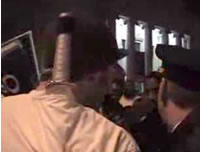
I want to apologize personally to the many conservatives who are frightened by the video of a man arrested on election eve for wearing a McCain T shirt to an Obama celebration in South Philadelphia. I would be frightened too, if I were in your shoes. Even those conservatives who do not buy into the radical version of the Biblical End Times may have raised an eyebrow at this apparent fulfillment of the prophecy that Christians will be arrested as a first step.

If this video were only as it appears to be, it would be a travesty. However, if you watch the longer version it becomes clear that the young man set up the situation intentionally and exacerbated it by wearing a toy dagger protruding from the back of his T shirt. Also note that Philadelphia has a history of street violence such that police had reason to be nervous as crowds filled the streets.

Mutual fear
Nevertheless, this incident is most unfortunate and bespeaks a deeper issue--the fear of each other by many liberals and conservatives. Many postmodern liberals treat conservatives with a disdain that conservatives have every right to be offended by. I know because I was one of those postmoderns (though never with the label of liberal; see Why I am a Recovering Libertarian.) First I lumped all conservatives together--not noticing the huge range in intellectual, ethical, and theological orientation. And then I thought that anyone who took the Bible literally was either ignorant or immature. But when circumstances dropped me into an unusual fundamentalist church, my experience actually living among the fundamentalists for two years changed all that. I came to respect their love and their passionate committment to a better world for all through what they called "The Kingdom of God."

Of course, many of my friends have had very different experiences with orthodox Christian churches. A gentle friend told me yesterday how for her, the fear has lifted for the first time in her life since the election. "It took me several days to feel the full effect as I found myself walking taller," this older woman said. She has spent many years in personal and spiritual growth work learning forgiveness and nonjudgment for her rigid Christian upbringing. I truly believe if she had been there that night, she would have reached out an arm to the young man with the T shirt and invited him to join the party--her and female partner.

What will it take for all of us to move to this kind of reponse to each other?

Friday, October 24, 2008

Transpartisan Values 2: Measuring Them

In Part 1 of this post I noted that Jonathan Haidt's "Real Difference Between Liberals and Conservatives" fueled my belief that conservative and liberal values converge as we mature, birthing integral transpartisans. If that's true, the historic opportunities of Obama's presidency require us to recognize this new animal. For starters, let's see how we might use data like Haidt's to identify integral conservatives.

Caveat 1: My Political Bias
To understand my bias, see my post Why I am a Recovering Libertarian.

Caveat 2: Fools Rush In
I don't know much about tests to measure your level of development; what I know is from a conference call in 2007 with David Zeitler of Integral Institute. My impression is that the available tests are big, complex, and expensive. So this post is a case of fools rushing in where the really smart guys advise caution.

Sorting most conservatives from most liberals
The questions in Haidt's Five Foundations survey are simplistic, but as such they are perfect for filtering most liberals from most conservatives. For the moment I'm going to go with Karl's assumption that most conservatives are at purple-red-blue-orange (in Spiral Dynamics), while most liberals are at blue-orange-green. But I also suspect that some liberals are lower while some conservatives are higher. And remember, according to Integral Theory, "higher" means having a broader perspective that encompasses more experience.

The preamble to all questions in Haidt's Five Foundations survey is, "When you decide whether something is right or wrong, to what extent are the following relevant to your thinking? " One of the questions asks "Whether or not someone showed a lack of respect for authority." It seems likely that
  • A conservative at blue is going to choose "Very Relevant" fast enough to make your head spin.
  • A liberal at green is going to be just as fast to choose "Not Very Relevant."
  • But everybody else is going to pause. Any liberals at the conventional level may well think, Most conservatives respect authority too much; I don't want to be associated with conservatives, so I will downshift my answer a notch or two, perhaps to "slightly relevant."
  • And anyone at the yellow level or above is going to start asking questions about the context.
    • Is it a legitimate authority?
    • Did the authority violate its trust?
    • Were all respectful options exhausted?
    • Was the system itself at risk of harm?
In other words, persons at the integral level are going to feel they do not have enough information, and thus they will answer either at the middle "Slightly Relevant" or at the bottom "Not at All Relevant." Thus we get the deceptive appearance that respecting authority is not an integral value, when, in fact, respecting appropriate authority gets a great deal of attention at yellow.

Human guniea pig: my own results on Haidt's survey
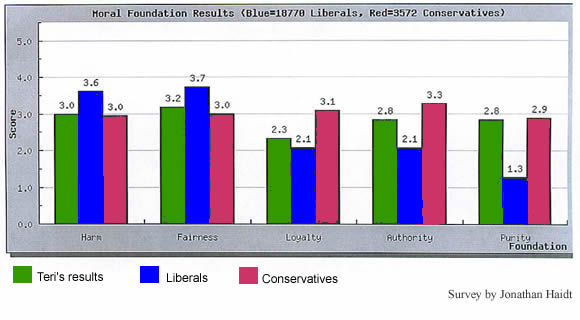
Considerations like these show up in my own test results shown in the chart below:


  • With liberals, I ranked low on loyalty. (I'd only die for my country if I thought we were protecting someone from harm)
  • With conservatives I ranked high on purity/sanctity. But I'm a libertarian on purity (e.g., not only are laws against homosexuality wrong, but laws against drugs and prostitution are wrong, too). So what's up with that ranking? Could it be the hour I spent trying to decide my answer to the weight on "what God wants"? (For more on purity and sanctity, see my One chart that Explains Religion.)
  • With conservatives I ranked a bit lower than liberals on harm and fairness. Regarding harm, I can remember the exact day I down-shifted. Someone had to be removed from a team to keep from holding the team back. I agonized over the decision as someone I respected said, "I see why you have to do this, but she will be hurt." I did it anyway and hoped I never had to make a decision like that again.
  • On respect for authority, I ranked half way between the liberals and conservatives, perhaps largely because of the experience I just mentioned
Of course, I consider my ethics to be at yellow or higher. (And please, if you see evidence that I'm backsliding to blue, do tell me. Maybe I've got Stockholm Syndrome from my two years living among the fundamentalists.) So of course what I'm interested in is a means to distinguish the way people like me weigh all five values from the way somebody at blue weighs them.

Screening for Transpartisans

How do we enhance a survey like Haidt's to make such a distinction? I think Karl is right (see his comment on my prior post); Each level has a primary value against which it filters or screens all other values. Thus, liberals at green or ornage screen out value on place on purity, loyalty, and sanctity to avoid any possible conflict with their primary values of fairness and protection from harm. Thus, our questions would need to screen for
  • the person's primary ethical value (e.g., those for whom fairness and care always trump purity, loyalty, and authority.)
  • the scope of the ingroup to which loyalty, fairness, and care are applied (family, tribe, or world)
I am imagining a survey that does this in two stages.

Step 1: find the liberals who hold all five values
Our first test would use questions like those in Haidt's Five Foundations survey and simply pad them with qualifiers.
  • A generic qualifier at the start that would reassure the libertarians that "These questions do not concern the passing of laws or use of punishment. They deal solely with how you personally feel about what is right and wrong."
  • A qualifier specific to each question for anyone at post conventional, e.g., "In a situation in which you personally believe that someone showed a lack of respect for legitimate authority..."
This should move some of the liberals into the group who claim to weigh all five values. In fact, anyone who doesn't move, according to my thinking here, is basking in a pure experience of orange or green. They do not proceed onto the next survey.

Step 2: Filter out the blue
Presumably we now have a pool of blue, yellow, and beyond. The next step is to sort out those at blue: those who will always prioritize purity, loyalty, and authority as predicted by the spiral, and those whose scope of care is less than worldcentric. This sorting so would require questions carefully designed to get at the motives or perspectives behind the answers.

If these two steps indeed filtered blue, orange, and green, I suspect they would also filter out most of those with a strong political identification as liberal or conservative. Those left will identify themselves politically as independent, libertarian, or "other." These are our potential transpartisans. And I believe that if you ask them how they identified themselves previously, you will get a mix of those who have transcended both "liberal" and "conservative" labels. (More about why/how in a future post.)

Know it when I see it
But the more I look at this, the more I realize the big boys are right: no test can sort the levels adequately--partly because nobody could be trusted to score it. For me it boils down to having conservative friends whose behavior over an extended period tells me they're at integral--or higher. They take big risks to prevent harm to people outside their ingroups; they agonize over questions of appropriate authority; and they realize that whatever form salvation comes in, it must be available to all.

Can we reach out a hand to these transpartisans whose path to integral may have been so different from our own?

Tuesday, October 21, 2008

Transpartisan Values 1: Liberal and Conservative?

You know how it is when you leave a partner or a paradigm behind, you focus on everything that was wrong with it? I have a suspicion that's what's at work for many of us when we outgrow and turn against values we were raised with—like loyalty to our ingroup. Integral Theory tells me there are higher levels at which we re-integrate those values; we transcend and include them. And I believe that when we get to those levels, former "liberals" and "conservatives" will meet up as integral transpartisans.

Five universal values
I got a new way to think about this in Jonathan Haidt's "The Real Difference between Liberals and Conservatives." In his TED video, the social psychologist tells his mostly liberal audience they could achieve more of their agenda if they'd drop some of their prejudices against conservatives. Unfortunately his talk introduces his findings in a way that could be offensive to conservatives, thus diluting his effectiveness. But his message is clear in the paper in which he defends his "Five Foundations Theory." It claims that five values undergrid the world's many moralities, but liberals and conservatives emphasize the values differently.
He says liberals and conservatives value these two about equally
  • Care/Protection from Harm
  • Reciprocity/Fairness
But generally, conservatives place more emphasis on
  • Authority/Respect
  • Loyalty/Ingroup
  • Purity/Sanctity
Haidt concludes:
We in psychology, and in academe more generally, have a tendency to reject conservative concerns related to ingroup, authority, and purity as "bad" on the grounds that they often conflict with the "good" moralities of harm and fairness. We dismiss the conservative outgroup's morality as "motivated social cognition" driven by non-moral concerns such as fear of change. Doing so makes us feel good, but it should not, for it is a violation of our values (we become "politico-centric"), and it is a route to irrelevance (we cannot persuade the electorate, because we do not have an accurate picture of their moral motivations)...

[For example] Conservatives and many moderates are opposed to gay marriage in part due to moral intuitions related to ingroup, authority, and purity, and these concerns should be addressed, rather than dismissed contemptuously... Recognizing these foundations as moral (instead of amoral, immoral, or just plain stupid) can open a door in the wall that separates liberals and conservatives when they try to discuss moral issues.
I can say a loud "Amen" based on my experience living among the fundamentalists for two years. When I worked hard to understand their concerns about homosexuality, the result was a willingness to drop their support of gay marriage bans—because, "Judgment is up to God, not the government." While this outcome is not wholly satisfactory to many, the question is, would you rather make progress like this or is it more important to keep proving how wrong the other side is?

Beyond Merely Acknowledging Conservative Values
I can hear most of my integral buddies saying, "OK, fine, conservatives have ethical values. But Spiral Dynamics shows us they are low-end ethics." And that's half true. But mapping Haidt's data against the spiral makes it clearer than ever to me why we must reintegrate those "conservative" values as we reach the higher levels. Haidt implies this by asking, "Why has the moral domain shrunk for educated secular Westerners?" Instead of merely transcending and tolerating conservative values, we must also find a way to include them.

Research indeed backs up the liberal feeling that some conservatives' ethics are lower. (An integral perspective tells us that a "higher" value is one with a bigger perspective—it takes more into account.) In Kohlberg's famous stages of development, purity, respect for authority, and loyalty arise in the early stages (pre-conventional and conventional), while care and fairness arise in the later post-conventional stages. [Update: Whoops, that last clause is wrong, as pointed out in Karl's comment below. Care & fairness emerge early. But they are weak until post-conventional because they are overshadowed by the primary values at the lower levels, and they are applied only to one's ingroup.] Thus Haidt asks whether the three conservative values are "just manifestations of Kolhberg's 'immature' conventional morality stages." If we look through the lens of an integral perspective, the answer is "yes" in the lower stages but "maybe not" as we approach the top.

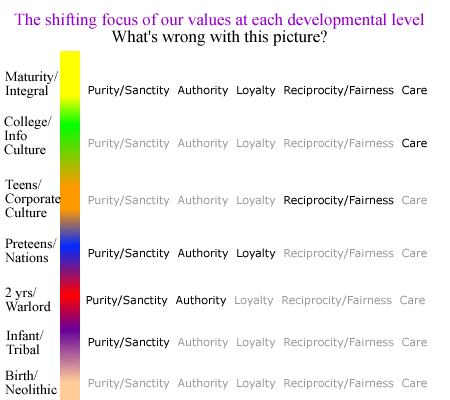
One of Integral's best tools is Spiral Dynamics, a scheme which elaborates on Kohlberg's stages with the insight that values emerge in a natural progression that loops from concern for the individual to concern for the group. Haidt's five values map perfectly to the Spiral levels as shown below.

(The grayed values are inactive, and the line of grayed values at the bottom level represents my inclination to go along with Haidt's claim that we are born with a "taste bud" for these values. This contradicts Spiral Dynamics' claim that values emerge from experience. But it's my chart, so I'm going out on that limb.)

At first glance at this chart, liberals may be tempted to say, "See, our orange/green values are higher than conservatives' red/blue values." For even when blues try to be good Samaritans, providing care to an outgroup, they can only provide the kind of care they themselves would want. It's not till green that we can take another's perspective--love our neighbor as ourselves.

But look closely and notice what happens at the orange level of teens, corporate culture, and the Enlightenment. Up until this level, the values have been coming into focus and staying in focus. But Haidt's findings seem to suggest that the teenager now breaks with convention, rejects the first-flowering values of purity/sanctity, authority, and loyalty, and he or she substitutes the new values of reciprocity/fairness and then care/protection from harm. We feel we have transcended the "lower" values. In the case of loyalty, for example, we shift our loyalty from our ingroup to all humans, or to an ideal, or even to ourselves, recasting it as "to thine own self be true." "Loyalty" feels outdated.

Integrating all five at the high end
But notice the yellow "integral" level at the top of the chart. This is the level at which we integrate the values of all prior levels. This is the level at which we reclaim the previously transcended values. We see that authority, loyalty, purity, and sanctity have a rightful place in higher level morality and we want them back.

We'll know we have thus transcended and included each of these values when we can consciously choose among them from a broader perspective. Indications that we are at this level include
  • We are not knee-jerk controlled by any one value
  • We are passionately for each value without being against the others
  • We can access each value when appropriate
  • We avoid extremes by integrating opposites: For just as too much loyalty breeds revenge, we come to see that too much reciprocity breeds heartless legalism and too much care breeds what Buddhists call idiot compassion.
  • We are not 100% sure we are right but we are willing to make tough choices in full humility that we may be wrong
  • We loosen identity with a political party, seeking to become transpartisan
Taking loyalty as an example, our top loyalty may indeed now rest with an ideal or with all people, instead of with our ingroup of family, community, tribe, or nation. But when our ingroup needs help, distinctions between our needs and its needs may seem less sharp. I believe each of the transcended values must be re-included in a similar fashion if we are to be truly mature. And if the idea of re-valuing "purity" gives you the hives, ask yourself if you wouldn't be the least bit uneasy if your spouse was using pornography or your teenager was frequenting casual sex parties. Voila the remnants of the moral taste bud for purity. Do we really have no more use for it? (For everything you need to know about purity and sanctity, see my One chart that Explains Religion.)

So who holds all five values?
If people at the upper level weigh all five values, why doesn't Haidt's research show any liberals holding all five values? I can see three reasons.
  • Haidt's questions aren't designed to sniff out the distinctions in the list above. So a person at the integral level who weighs loyalty to family against loyalty to every other human being may not test out as being "loyal" at all (see Karl's fantastic comment below)
  • Haidt apparently drops data from those who identify themselves as "independents," "libertarians," or "other," and those are exactly the categories in which the integral transpartisans may be hiding out
  • Ethical values are only a subset of the values that distinguish conservatives from liberals, and those labels don't take into account variation within the two camps--as identified in my One Chart that Explains all Politics
But of course, the other side of the question of why no liberals hold all five values is why all conservatives do. I believe the answer is that some of these conservatives are at integral. (In a future post I'll assess the shortcut (hint: ladder) that I think got them there.)

Distinguishing high level values from low level
The problem is, it can be impossible to tell the difference between someone acting at a higher level (with a broader perspective) and someone at a less mature level.

Let's take, for example, Sarah Palin's demotion of her state trooper brother-in-law. From the publicly available details, it appears Palin chose loyalty over reciprocity and even over respect for authority. Most everyone will agree that would be wrong and extremely dangerous in a public leader. But if you are a conservative pre-disposed to like Palin, you may look for evidence there were extenuating circumstances such that she did what she felt she had to do to protect her family from imminent harm. On the other hand, if you are a liberal pre-disposed to dislike Palin, you are more likely to assume she acted from the shadow side of loyalty, taking revenge into her own hands. From the outside, those two acts look the same.

And that's what's wrong with so much religious and political debate today. We assume the highest motives for our side and assume the lowest for the other side. What could happen if we flipped that script—checking ourselves for lower motives while giving our opponent the benefit of the doubt about theirs? My experience shows that the release of pressure we get when we do so creates space for something new to happen.

Haidt seems to agree.
Social justice researchers might benefit from stepping out of the"good versus evil" mindset that is often present in our conferences, our academic publications, and our private conversations. One psychological universal (part of the ingroup foundation) is that when you call someone evil you erect a protective moral wall between yourself and the other, and this wall prevents you from seeing or respecting the other's point of view.

It's more entertaining to watch people throw rocks at each other over the wall than it is to watch the slow, difficult process of dismantling the wall...
My next post will kick around the kinds of survey questions that could distinguish integral transpartians who truly weigh all five values from those conservatives who see themselves as attempting to do so but who always end up privileging the earlier values over the later ones. And I'll be asking for your help. Take a moment to subscribe below so you won't miss a thing.